
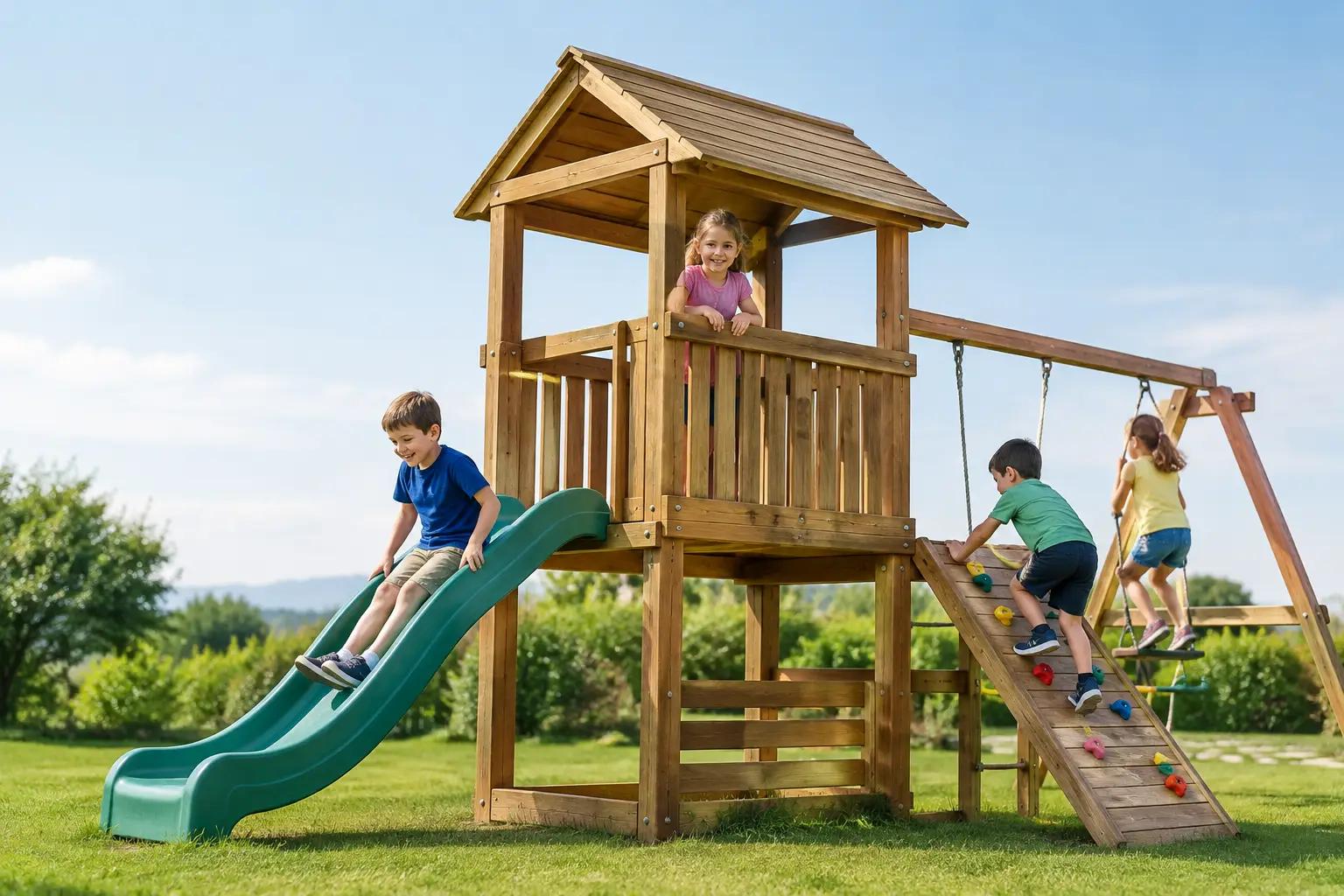
How many children can fit in a children's play tower?
The question “how many children can a play tower accommodate?” may seem like a simple matter of counting, but the correct answer cannot be determined by a rough calculation based on square meters alone. A play tower is a system of platforms, entrances, stairs, nets, slides, and observation points. Each of these areas is used differently, carries different loads, and presents different levels of risk. For operators of hotels, schools, residential complexes, and public spaces, this is critical: capacity must provide joyful play, freedom of movement, and predictable safety at the same time.
How Many Children Can a Tower Accommodate According to Its Design?
There is no universal number that applies to every tower. A compact tower with a single platform and slide may be designed for a small group of children, while a multi-level structure with bridges, climbing nets, and multiple exits can accommodate significantly more users. However, this does not mean that all children should gather on a single platform at the same time.
The design capacity is determined both for the entire play system and for its individual components. The manufacturer takes into account the permissible structural loads, the number of available routes, the size of the play platforms, the fall height, and the ability of children to pass one another without collisions. This is why signage with rules and age restrictions is not merely a formality. It is an essential part of safe operation.
For project owners, the more useful question is: how many children can play simultaneously within the area without creating conflicts or dangerous congestion? The answer should be incorporated into the concept from the beginning, not addressed after installation.
Capacity Is Not Just a Matter of Structural Strength
A quality tower must withstand dynamic loads from climbing, jumping, and movement, but structural strength is only part of the picture. A component may be strong enough to support more children, while the surrounding space may not allow them to use it safely.
For example, a slide has a limited usage rhythm. A child climbing toward it should not encounter another child sliding down or waiting in the landing zone. Rope bridges and narrow passages naturally slow traffic flow. If these points are not considered, high visitor numbers can lead to waiting, rule-breaking, and tension between children.
A well-designed tower distributes play activity. It offers more than one climbing route, separate activities on different levels, and clearly defined exits. As a result, children are not competing for a single platform but move through the experience in a more natural rhythm.
Age Changes the Required Capacity
Ten three-year-olds use space very differently from ten nine-year-olds. Younger children need lower elements, wider steps, more accessible handrails, and more time for every movement. They also typically require closer adult supervision.
Older children move faster and seek greater challenges. For them, rope courses, climbing panels, taller towers, and connecting bridges may be appropriate. If the same system is intended to serve a broad age range, the different zones should be clearly separated. This prevents older, more confident children from overwhelming younger users and makes visitor management easier for operators.
The Fall Zone Matters Too
A sufficient impact-absorbing surface and clear safety zone are required around the tower. This area is not intended for waiting, parking strollers, or placing additional furniture. When the landing area of a slide or swinging element becomes crowded, the risk increases, even if the structure itself is in perfect condition.
This is why capacity should be planned at the level of the entire playground. A tower that looks impressive in a rendering may not be the right choice if access to it is narrow or if the surrounding area does not support a safe flow of families.
How to Determine the Right Capacity for a Specific Project
The process begins with the actual usage scenario. In a hotel resort, usage is usually concentrated at specific times of day and during particular seasons. In a kindergarten, the playground is used according to a structured schedule. In a shopping center, visitor numbers may fluctuate significantly, with peaks during weekends and bad weather. The same tower size will not produce the same results in all these environments.
During planning, the expected number of children, age profile, available staff, and intended purpose of the space are analyzed. If the objective is to encourage families to stay longer, a variety of activities is preferable to a single large tower. If space is limited, a multifunctional structure with well-organized levels may be more effective than a collection of unrelated elements.
The project should also include an operational plan. Who supervises the area? How is access managed for organized groups? Where can parents maintain visibility of their children? Are there clear rules regarding age, height, and simultaneous use? These decisions determine whether the intended capacity will function effectively in a real-world environment.
Standards, Documentation, and Responsibility
For public and commercial playgrounds, safety cannot be based on assumptions. Depending on the market, the project should comply with applicable standards and local requirements, including European standards EN 1176 and EN 1177, or relevant U.S. guidelines such as ASTM and CPSC standards. These standards address not only materials and structural components, but also openings, guardrails, clearances, heights, access, fall zones, and surfacing.
Manufacturer documentation should clearly specify the intended use of the equipment, the target age group, and the instructions for installation, maintenance, and inspections. This is important for every facility owner because responsibility continues after installation. Regular visual inspections can identify loose fasteners, worn ropes, damaged panels, or changes in surfacing before they become significant issues.
Professional installation is just as important as good design. An improperly constructed foundation, incorrectly tensioned ropes, or compromised surfacing can affect the performance of an otherwise excellent tower. For complex projects, it is often wise to work with a single partner that coordinates everything from concept and engineering to installation and final handover.
How to Avoid Overcrowding During Peak Periods
The most common mistake is assuming that a larger tower automatically solves the problem of high visitor numbers. If all children are attracted to the same slide, the highest platform, or a single access point, congestion remains. The solution lies in distributing interest.
A successful play area combines a central tower with complementary activities, such as rope elements, balance trails, sensory panels, imaginative play zones, and dedicated areas for younger children. This creates choice and reduces pressure on any one attraction. For a hotel or restaurant, it means a more enjoyable experience for parents. For a municipality or school, it means better inclusion of children with varying abilities and confidence levels.
During periods of particularly high attendance, staff can manage flow through simple on-site rules, observation, and rotation of groups. This should not turn play into a rigid process. The goal is to provide children with enough space for choice, movement, and imagination, ensuring that no one is excluded from the experience.
An Investment in Play That Works Long Term
When choosing a tower, do not focus solely on how many children can climb onto it. Look for a solution that serves the expected visitor numbers, suits the target age group, and remains safe and attractive after years of active use. Premium materials, engineering precision, and durable construction reduce the risk of unexpected repairs and protect the value of the investment.
Edutain Attractions approaches every play environment as a complete experience, with a clear purpose for the property, space for children's enjoyment, and disciplined attention to safety and execution. The best tower is not the one that gathers the largest number of children in a single place. It is the one that provides more ways for them to play confidently, actively, and together.
FAQ
1. How many children can a playground tower accommodate?
There is no universal number. Capacity depends on the tower's size, number of platforms, slides, climbing routes, activity zones, and overall playground design.
2. How is playground tower capacity determined?
Capacity is based on structural load limits, platform sizes, circulation routes, safety clearances, fall zones, and the ability of children to move through the structure safely and comfortably.
3. Why isn't capacity determined only by structural strength?
A tower may support a high physical load, but narrow access points, slides, bridges, and landing areas can create bottlenecks. Safe capacity depends on user flow as much as structural durability.
4. Does the age of children affect playground capacity?
Yes. Younger children move more slowly and require additional supervision and space, while older children tend to move faster and use equipment differently. Capacity planning should always consider the target age group.
5. Why are safety zones around the tower important?
Impact-absorbing surfacing and adequate clearance areas help reduce injury risk and prevent collisions. These zones should remain free from obstacles and additional equipment.

Maria Mihova
Published on: October 21, 2026 | Last Updated: October 21, 2026Founder & CEO at Edutain Attractions
Maria designs and delivers immersive, educational play experiences for hotels, municipal parks, and resorts worldwide. With over 15 years in international business development and adventure products, she builds play environments that combine safety, learning, and fun. Find out more about me
