
Family-Friendly Areas in Hotels That Keep Guests Coming Back
A child who has nothing to do between breakfast and a trip to the pool can influence an entire family’s perception of their stay. That is why family zones in hotels are not simply an amenity or a decorative play corner. They are an essential part of the guest experience, affecting hotel selection, length of stay, on-site spending, and the likelihood that guests will return.
For hotels and resorts that want to become a preferred choice for families, a well-designed play area is a strategic asset. It gives children the freedom to move, explore, and interact with others, while providing parents with peace of mind that their children are engaged in a safe and visible environment. When professionally designed, such a space remains equally effective during peak season, on rainy days, and in the hours between scheduled activities.
What Families Expect from a Hotel Environment
Today’s parents are not simply looking for a room with an extra bed. They evaluate whether a hotel understands the rhythm of a family holiday: the need for activity, the short attention spans of young children, the importance of shade and comfortable seating areas, and the ability for children of different ages to enjoy themselves without constantly getting in each other’s way.
This creates a significant challenge for hotel operators. A children’s play area needs to look appealing in photographs, but it must also withstand intensive daily use. It should be easy for parents to supervise, without turning play into a sterile or overly restrictive experience. The best solutions achieve this balance through thoughtful spatial design, high-quality materials, and a variety of physical activities and challenges.
A hotel with well-planned family-friendly facilities benefits far beyond its youngest guests. Parents are more likely to spend additional time in the restaurant, extend their stay, and view the property as genuinely attentive to their needs. For hotel managers, this means stronger positioning in a highly competitive market segment, reducing reliance on price, location, or seasonal promotions alone.
Family Zones in Hotels: Start with Guest Behavior
Before choosing a slide, a rope structure, or an indoor play center, it is essential to understand how guests will actually use the space. This is the difference between an attraction that sits empty after the initial excitement fades and a play area that naturally becomes a favorite destination throughout the entire stay.
In seaside and mountain resorts, children's play areas often experience peak demand at specific times of the day, such as before dinner, during the midday heat, or when weather conditions limit outdoor activities. Urban hotels may benefit more from a compact indoor solution that adds value for weekend guests and organized family events. Holiday resorts, on the other hand, have the opportunity to create larger outdoor environments that can become a defining feature of the property's overall identity.
Planning should take into account the age profile of guests, expected capacity, seasonality, and the location of the play area in relation to the reception, restaurant, swimming pool, and restroom facilities. A zone placed too far from the natural flow of family activity may go largely unnoticed. Positioned too close to a noisy or potentially hazardous service area, it can create frustration for both guests and staff.
Age-Based Zoning Is Essential for Both Safety and Experience
A two-year-old and a ten-year-old have very different physical abilities, interests, and levels of risk tolerance. When children of all ages are placed in the same small play structure, younger children often become discouraged, while older ones quickly lose interest. A more effective approach is to create connected yet clearly differentiated play zones.
For toddlers, the ideal features include low-level play elements, tactile panels, soft surfaces, and activities that support balance and coordination without introducing height-related challenges. Preschool-aged children benefit from slides, bridges, themed play features, and areas designed for imaginative and role-playing activities. Older children are most engaged by climbing structures, rope courses, nets, low-level adventure trails, and dynamic obstacles that encourage confidence, problem-solving, and cooperation.
This does not necessarily mean building three separate playgrounds. With thoughtful design, different levels of challenge can be integrated into a single visual concept, whether it is a nature-inspired adventure, an expedition, a castle, or an imaginary city. The important thing is that the transitions between zones are clear, visible, and safe.
Outdoor, Indoor, or Hybrid Play Areas
The right format depends on the property’s business model, local climate, and available space. An outdoor playground creates a strong visual impact and naturally encourages families to engage in active outdoor play. Timber structures, rope courses, and climbing elements can be designed to complement the surrounding landscape rather than appear as equipment added as an afterthought.
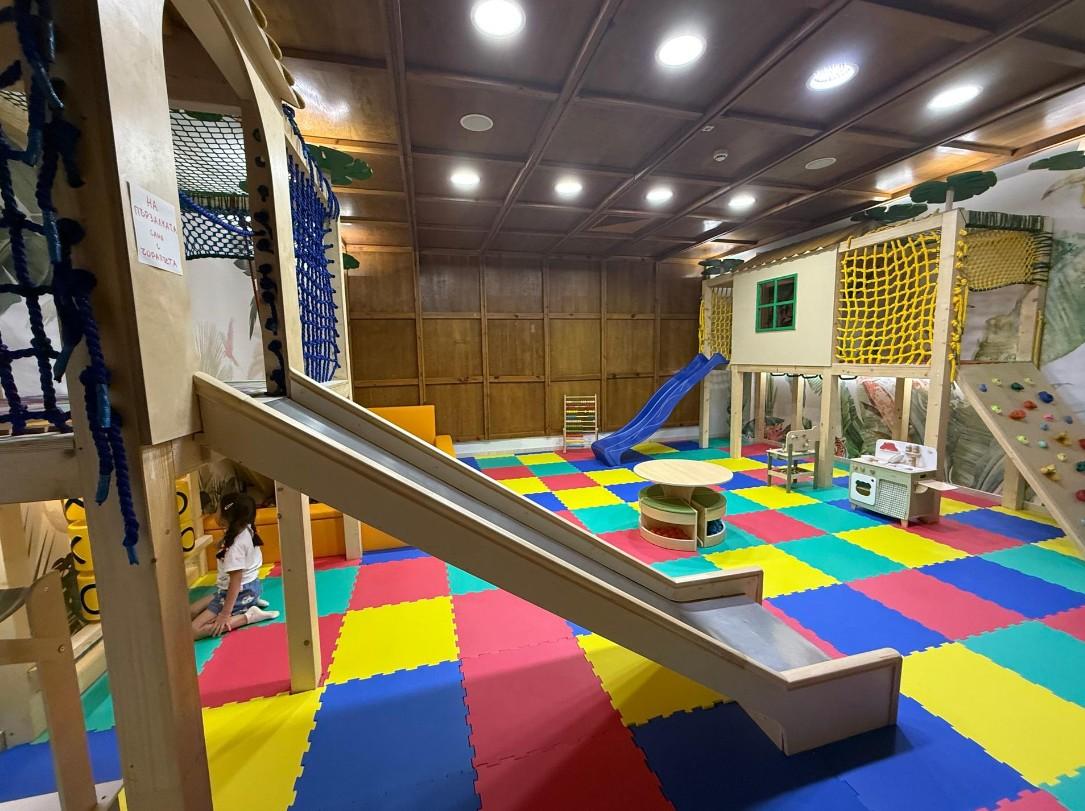
An indoor play center is particularly valuable for hotels that operate year-round. It reduces dependence on weather conditions and remains a useful attraction during early spring, rainy days, and winter holidays. A well-designed indoor play area does not need to be filled with brightly colored plastic equipment. Instead, it can reflect the same premium atmosphere as the rest of the hotel through a carefully selected color palette, natural textures, themed design elements, and high-quality lighting.
For larger resorts, a hybrid approach often delivers the best results. The outdoor area provides scale, movement, and opportunities for active play, while the indoor space offers a reliable alternative and a setting for quieter activities. The business logic is straightforward: guests should never feel they have run out of reasons to stay and enjoy the property when outdoor plans change.
Safety Is Designed In, Not Added at the End
Safety is not a checklist of warning signs placed next to a finished playground. It begins with the engineering design, the choice of materials, fall-height considerations, impact zones, and the way individual play elements work together. In a hotel environment, this is especially important because the users change every day and are unfamiliar with the space when they arrive.
A professionally designed play area includes appropriate impact-absorbing surfacing, controlled access points, clear visibility for parents and caregivers, and effective separation from vehicle routes, water features, and service areas. Materials must be able to withstand changing weather conditions, frequent use, and intensive cleaning. A low-cost solution may look acceptable on opening day, but its compromises quickly become apparent through wear and tear, difficult maintenance, and an inconsistent guest experience.
A realistic operational plan is equally important. Staff should understand how to carry out daily visual inspections, how to respond when a defect is identified, and when periodic technical inspections are required. A certified working process, including the principles of ISO 9001:2015, brings discipline to quality control throughout every stage of the project, from design and manufacturing to installation and final handover.
Visibility Gives Parents Peace of Mind
Parents do not always want to take an active role in play, but they do want to be able to keep an eye on their children with minimal effort. That is why seating areas, cafés, and terraces should be positioned with a clear view of the main play zones and activity routes. While this may seem like a small detail on a design plan, it has a significant impact on how comfortably and frequently the space is used.
Good visibility does not mean creating an open, characterless space. Landscaping, themed features, and separate activity areas can all be incorporated, provided they do not create hidden corners or blind spots. For larger play structures, clearly defined entry and exit points are especially important, as is ensuring that staff can quickly and easily access every part of the facility when needed.
The Design Should Reflect the Character of the Hotel
A standard playground rarely leaves a lasting impression. When a family zone reflects the story of the property, the character of the surrounding landscape, or the hotel's architectural style, it becomes a memorable part of the guest experience. A mountain hotel might incorporate timber-inspired forms, rope bridges, and woodland adventure themes. A seaside resort, on the other hand, can draw inspiration from ships, lighthouses, or the underwater world without creating visual clutter.
Custom-designed play areas offer practical benefits as well. They allow the structure to be tailored to the actual site conditions, including available space, changes in elevation, existing trees, and architectural constraints. Rather than forcing a standard modular solution into the environment, a bespoke design can take full advantage of the location and transform an otherwise underused area into a destination in its own right.
For Edutain Attractions, this means managing the entire process, from concept development and creative design to engineering, manufacturing, delivery, and on-site installation. This integrated approach ensures that every solution is aligned with the hotel's operational requirements, the expectations of families, and the long-term value of the investment.
Measure Success After the Opening
The impact of a high-quality family zone cannot be measured solely by the number of children using the playground. Monitor guest feedback, repeat bookings from families, restaurant and shared-space usage around play periods, as well as interest in holiday and weekend packages. Feedback from reception and entertainment staff is equally valuable, as it helps identify which age groups use the area most frequently and where operational challenges may arise.
In many cases, the best investment is not the largest play structure, but a space with a clear purpose, adequate shade, safe surfacing, and the right level of challenge for the property's typical guest profile. A successful project begins with a simple question: how do you want families to feel during their stay? Relaxed, welcome, and ready to extend their visit for one more day.
FAQ
1. Why are family zones a strategic asset, not a “kids’ corner”?
Because they influence hotel choice, stay duration, on‑site spending, and repeat bookings.
2. What do modern families expect from a hotel?
Activity, shade, visibility, seating, multi‑age play, durable materials.
3. Should planning start with equipment or guest behavior?
With behavior: peak hours, seasonality, flows, proximity to restaurant, pool, reception.
4. Why is age segmentation essential?
Safety + experience — different needs for toddlers, preschoolers, older kids.
5. How to choose between outdoor, indoor, or hybrid?
Based on climate, business model, available space, and seasonality.
Author: Maria Mihova
