
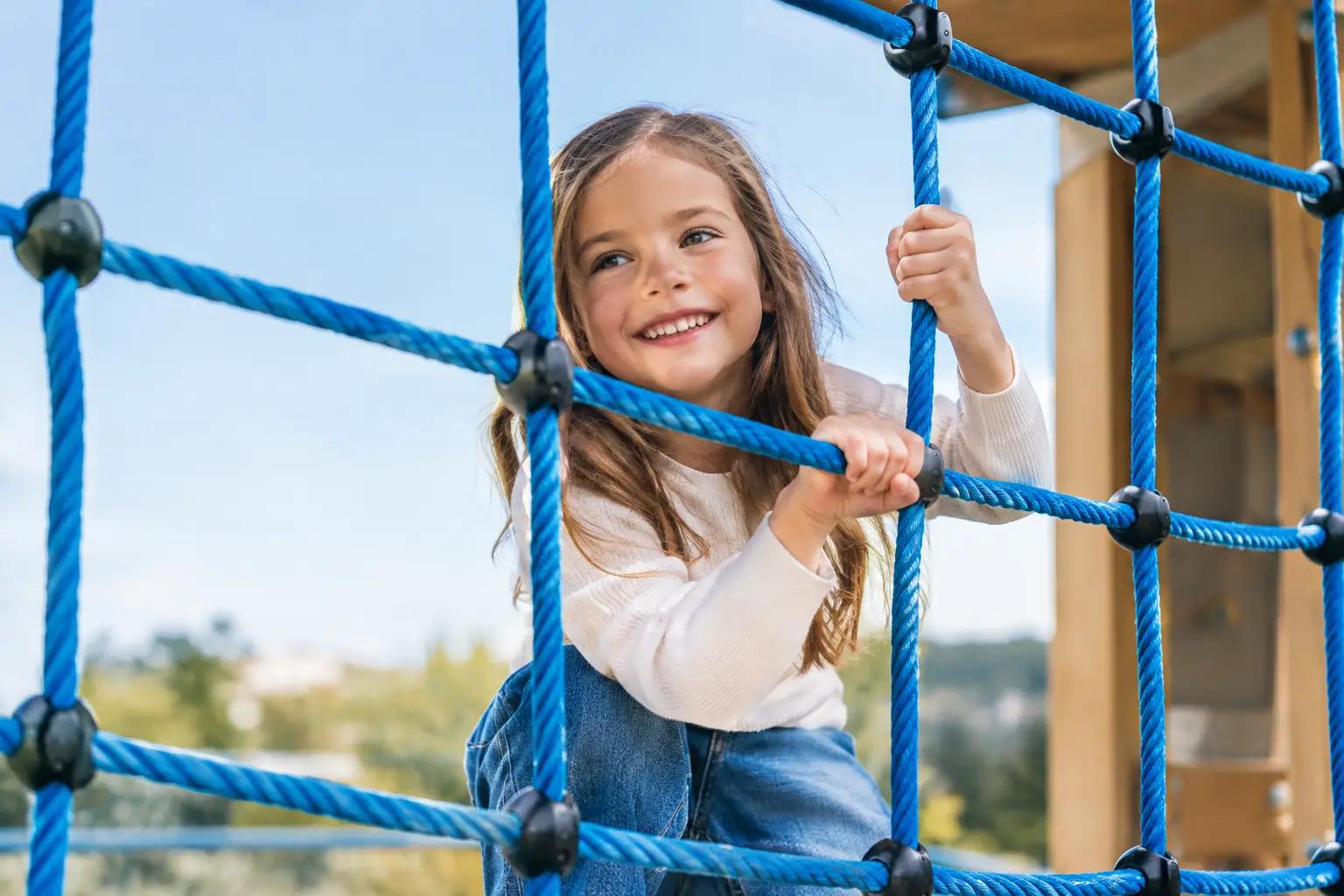
Are rope nets safe for children?
For a hotel, school, municipality, or residential complex operator, the correct answer is not simply “yes” or “no.” A rope net is safe when it is part of a professionally designed system, with precise calculations, appropriate materials, certified components, impact-absorbing surfacing, and competent installation. When these conditions are missing, even a visually impressive structure may present unnecessary risks.
Rope structures naturally attract children. They offer movement, challenge, and opportunities for cooperative play without imposing a single way to play. A child chooses a route, plans the next step, and builds confidence with every climb. However, this freedom requires a much higher level of discipline from investors and designers in every decision they make.
| Factor | Safe Rope Net | High-Risk Rope Net |
| Design | Individually engineered design | Generic solution with no adaptation |
| Materials | Steel-core ropes with UV protection | Standard ropes with low wear resistance |
| Surfacing | Certified impact-absorbing surfacing | Hard surfaces or natural ground |
| Installation | Installed according to design specifications | Installation without load-control verification |
| Maintenance | Regular inspections | Only addressed when a problem appears |
| Compliance | EN 1176 и EN 1177 | No documented verification |
Expert Insight: The safety of rope structures does not depend on a single element. The best results are achieved when the structure, ropes, surfacing, and installation are treated as one integrated system. This is why certified solutions are developed through a combination of engineering calculations, material testing, and real-world operational experience.
Are Rope Nets Safe When Properly Designed?
Yes, rope nets can be an exceptionally safe component of a playground or adventure zone when they are designed for a specific age group, expected usage levels, and operating environment. Safety is not a feature of the rope alone. It is the result of the entire system: the supporting structure, anchoring, knots, connectors, heights, openings, fall zones, and surfacing.
This is why off-the-shelf solutions that are not adapted to the site are rarely a good choice for public environments. A net that performs perfectly in an indoor children's center cannot automatically be applied to a coastal hotel playground, where humidity, salty air, and intensive use place different demands on materials and maintenance.
Professional design begins with questions that often remain invisible to visitors: How many children will use the structure at the same time? What are their ages? How accessible is the area for parents and staff? How is water drained around the foundations? Is there a risk of unintentionally moving onto a more difficult route? A well-designed rope net looks simple and fun, but behind it are precise engineering decisions.
Which Elements Determine Real Safety?
Rope Material and Protection
For commercial and public facilities, ropes should be designed for permanent outdoor or indoor use, not ordinary sports or decorative ropes. Steel-core ropes with durable polymer coatings are commonly used. They combine high load-bearing capacity, resistance to wear, and a comfortable feel for users.
High-quality coatings matter not only for appearance. They protect the structure from UV radiation, moisture, and mechanical abrasion while reducing the risk of sharp or frayed sections. Color stability is also important, especially in locations where visual quality is part of the guest experience.
Opening Size and Height
The size of rope net openings must correspond to the age and size of the children using them. Openings that are too large can create a risk of falling through or entrapment, while openings that are too small can restrict movement and turn play into frustration. There is no universal size. The correct solution depends on the net’s intended function and position within the overall play environment.
Height is equally important. Low nets designed for balancing and climbing allow free play with reduced risk, while large three-dimensional rope structures require controlled routes, safety measures, and carefully designed impact-absorbing surfacing. Scale may create strong visual appeal, but it should never come at the expense of safe use.
What Are the Main Risks and How Are They Prevented?
| Potential Risk | Cause | Preventive Solution |
| Falling | Insufficient protection of the landing area | mpact-absorbing surfacing |
| Entrapment | Inappropriate opening dimensions | Age-appropriate design |
| Rope wear | UV exposure and intensive use | Steel-core ropes |
| Corrosion | Moisture and weather conditions | Stainless-steel components |
| Structural deformation | Poor anchoring | Engineering-designed foundations |
Connections, Frames, and Anchoring
The most heavily stressed points in any rope system are often the connections. They must be resistant to repeated loading, protected against corrosion, and designed so they do not create hazards for fingers, clothing, or hair. These visually hidden details often determine whether an installation remains reliable after years of intensive use.
The same applies to posts, frames, and foundations. Supporting elements must withstand not only the weight of children but also the dynamic forces created by swinging, jumping, and group climbing. Professional anchoring takes soil conditions, drainage, and local climate into account.
Surfacing Beneath the Play Area
A rope net cannot be considered separately from the surfacing beneath it. For structures where falls are possible, the surfacing must be selected according to the critical fall height and must cover the required safety zone around the equipment. This may include specialized rubber surfacing, engineered wood fiber, or another solution tested for the specific application.
Hard surfaces, decorative stones, and ordinary grass should not automatically be considered acceptable simply because they look attractive. Selection should be based on impact absorption, drainage performance, maintenance requirements, and how the surface performs in heavy rain, cold weather, or intensive use.
Standards Are Part of the Project, Not a Formality
For public playgrounds and commercial facilities, safety must be managed through clear standards and documented processes. In Europe, the EN 1176 series establishes key requirements for playground equipment, while EN 1177 addresses impact-absorbing surfacing. Specific requirements vary depending on the market, the type of facility, and the purpose of the equipment, but the principle remains the same: solutions should be verifiable, not based on assumptions.
For project owners, this means requesting information about materials, structural calculations, applicable standards, operating instructions, and maintenance plans. A quality management system such as ISO 9001:2015 is also an important indicator of disciplined manufacturing and process control, although it does not replace compliance of the product itself with applicable standards.
Installation Can Turn a Good Design into a Risk
Even the highest-quality rope structure loses its advantages if it is installed incorrectly. Improper rope tensioning, level deviations, poorly fixed foundations, or incorrectly positioned surfacing can alter the behavior of the structure within the first months of use.
For this reason, installation should be carried out by a team that understands the specific system and follows the approved design. Final inspection is not an administrative step. It is the moment when stability, accessibility, safety clearances, and the integrated operation of all components are verified.
For complex projects, the safest approach is to have a single partner responsible for everything from concept to installation. This keeps the architectural vision, engineering solution, manufacturing, and on-site execution connected rather than fragmented among multiple contractors.
Maintenance Protects Both the Investment and the Children
Rope nets are designed for active play, which means maintenance should not wait until a visible problem appears. Daily or operational inspections can identify dirt, vandalism, loose components, or obstacles within the fall zone. Periodic technical inspections monitor the condition of ropes, coatings, connections, metal components, foundations, and surfacing.
Special attention is required after extreme weather events, nearby construction work, or unusually intensive use. For hotels and resorts, seasonal opening is a good opportunity for a complete inspection. For schools and municipal spaces, maintenance schedules should account for year-round use and peak periods.
An effective operational program includes at least the following four practices:
- Regular visual inspections performed by designated staff members.
- Documentation of findings and corrective actions taken.
- Immediate restriction of access when damage is suspected.
- Periodic professional technical inspections.
This approach does not reduce the freedom of play. It creates conditions where children can take natural challenges in an environment that adults have prepared responsibly.
How to Choose the Right Rope Net for Your Site
The selection process begins not with a catalog, but with the purpose of the space. For a restaurant with limited area, a compact low rope net may be ideal, keeping younger guests engaged without creating a visual barrier. For a resort, a large-scale rope structure may be more appropriate, becoming a recognizable feature and encouraging families to stay longer. In a school courtyard, the focus is often on varied movement, social interaction, and the durability required for daily use.
Good design does not make every challenge easy. It makes challenges understandable and age-appropriate while allowing children to develop at their own pace. A premium rope net is not merely an attraction within a space. It is a carefully created environment where confidence can grow alongside safety.
Frequently Asked Questions
Are rope nets safe for children?
Yes, when they are designed, manufactured, and installed in accordance with applicable safety standards and combined with appropriate impact-absorbing surfacing.
What ages are rope nets suitable for?
Depending on the design, they may be intended for children aged 3 to 12 years or for a broader age range.
What type of surfacing is required beneath a rope net?
The surfacing should be selected according to the critical fall height and must cover the entire required safety zone surrounding the structure.
How often should a rope net be inspected?
Daily visual inspections and periodic technical inspections are recommended, depending on usage intensity and the nature of the site.
How long do rope structures last?
With proper maintenance and high-quality materials, professional rope structures can remain in service for decades.

Maria Mihova
Published on: October 29, 2026 | Last Updated: October 29, 2026Founder & CEO at Edutain Attractions
Maria designs and delivers immersive, educational play experiences for hotels, municipal parks, and resorts worldwide. With over 15 years in international business development and adventure products, she builds play environments that combine safety, learning, and fun. Find out more about me
