
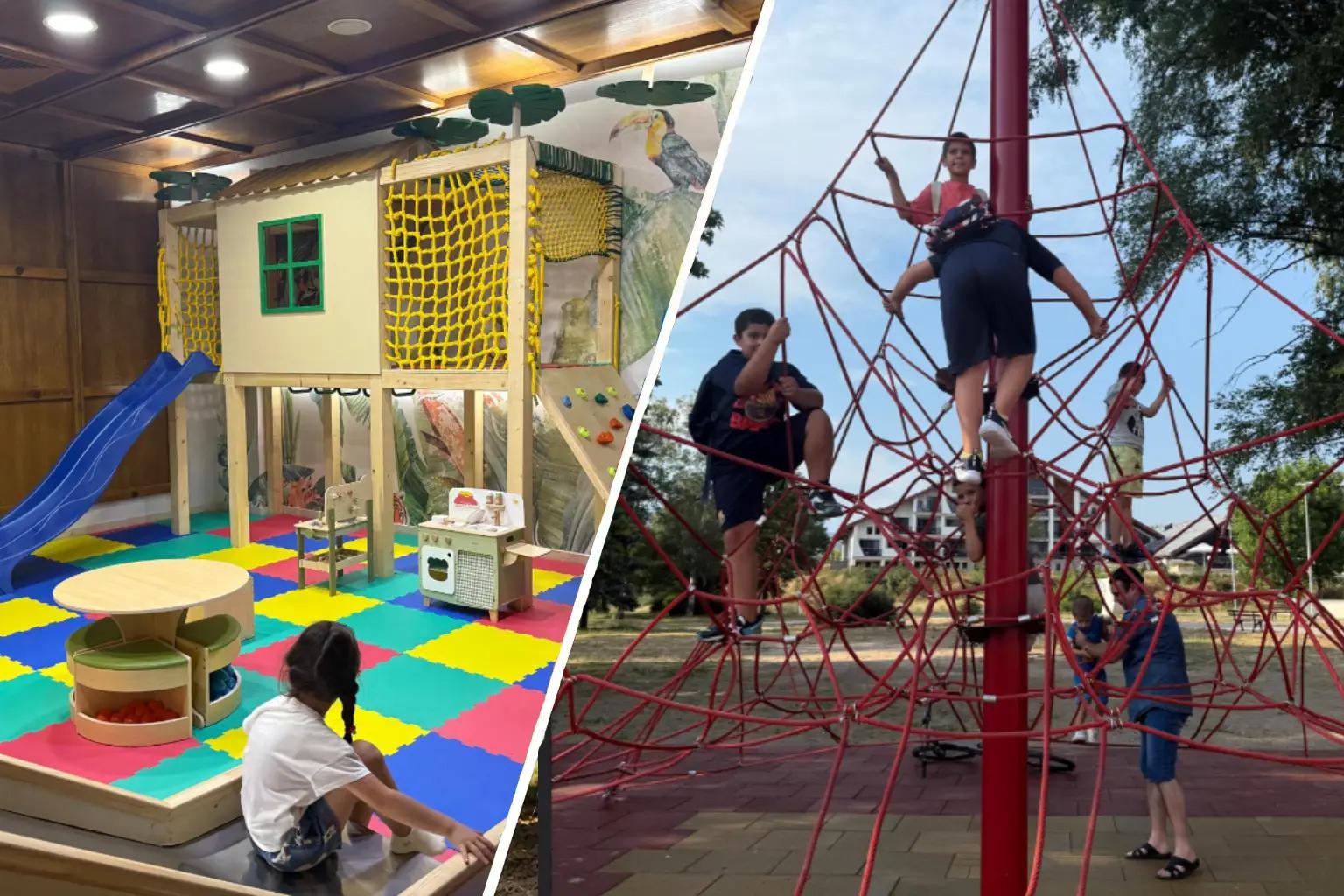
An indoor playground or an outdoor playground for children?
Families choosing a hotel, restaurant, or residential complex rarely evaluate the play area as a standalone element. They perceive the entire experience: whether children have space to move freely, whether parents can remain at ease, and whether the environment feels well‑maintained and safe. This is why the question “indoor centre or outdoor playground” is not simply a matter of location. It is a decision about how your venue attracts families, extends their stay, and creates value over time.
The right answer depends on climate, available space, visitor profile, operational model, and the ambition of the project. In many cases, the best result is not a universal format but an environment designed precisely for the specific venue.
Indoor centre or outdoor playground: what are you actually comparing
An indoor play centre provides a controlled environment. It enables year‑round play regardless of rain, strong sun, wind, or low temperatures. This is especially valuable for shopping centres, restaurants, family hotels, educational venues, and urban buildings where a consistent flow of visitors matters.
An outdoor playground offers something different but equally important: space, air, scale, and natural movement. Children can run, balance, climb, interact with the terrain, and play more loudly without affecting the rest of the venue. For resorts, residential complexes, municipalities, schools, and park areas, this is often the most visible family asset.
The difference is not between a “better” and a “worse” option. It is between two types of experiences and two different ways of managing an investment.
When an indoor play centre is the stronger choice
Indoor space performs best when the goal is predictability. For venues with year‑round visitation, this means the children’s area remains active even during periods when outdoor equipment cannot be used fully. It can turn an otherwise underutilised space into a reason for families to visit.
For a restaurant or hotel, an indoor centre can give parents time for a calm dinner, a meeting, or a moment of rest. For a commercial venue, it increases the time families spend on site. For a kindergarten or educational centre, it offers a protected opportunity for active play during unsuitable weather.
When designed well, an indoor centre should not be just a room with soft modules. Climbing elements, rope structures, interactive zones, role‑play corners, and balance routes can combine physical activity, imagination, and social play. What matters is that every piece of equipment has a clear role in the overall concept rather than simply filling square metres.
There is also an operational side. Indoor zones require quality ventilation, proper surfacing, lighting, acoustic control, cleaning access, and clear visibility for staff or parents. These details often determine whether the centre remains pleasant and easy to maintain after the first months of use.
When an outdoor playground delivers more value
An outdoor playground is a strong asset when you have visible open space and want to create a distinctive point of attraction for families. In hotel and vacation projects, it can become part of the landscape rather than a separate functional zone. In residential complexes, it adds real everyday value for residents. In municipal spaces, it creates a meeting place for children, parents, and neighbours.
Outdoors, children gain more opportunities for physical activity. Rope routes, low rope parks, swings, wooden structures, zip lines, and climbing elements encourage coordination, confidence, and cooperation. They offer challenges that children can choose according to their age and bravery.
However, the outdoor format must be planned with climate and real‑world usage in mind. Exposure to sun, rain, temperature changes, and intensive use places high demands on materials, coatings, drainage, and installation solutions. A good project also anticipates comfort for accompanying adults: shade, seating, clear routes, good visibility, and appropriate distance from vehicle access.
Year‑round usability does not disappear — it simply changes. In climates with pronounced seasonality, the outdoor playground may become a key summer asset rather than the only children’s service. This is not a disadvantage if it is correctly integrated into the venue’s business model.
Space is not just a matter of square metres
The most common mistake is starting with the question of how much area is available. A more useful question is what needs to happen within it. A small indoor zone can have a strong impact if it is designed for a specific age group and short but high‑quality play sessions. A large outdoor area can remain inactive if it lacks clear distribution between dynamic play, quieter activities, and spaces for adults.
The flow of people is just as important. Observe where families arrive from, where they pause, how strollers move, where queues form, and which zones need to remain quiet. The children’s environment must be accessible enough to be used spontaneously, yet sufficiently separated so it does not conflict with the venue’s primary function.
Safety is a design decision, not an add‑on
A safe play area begins long before installation. It depends on the selection of age groups, fall heights, free spaces, the type of impact‑absorbing surfacing, access, visibility, and the quality of connections. For indoor centres, evacuation routes, fire safety, and materials suitable for enclosed environments must also be considered.
Premium execution does not necessarily mean more equipment. It often means better‑selected elements, durable materials, and a structure that withstands real, intensive use. This reduces the risk of unplanned repairs, zone closures, and visitor disappointment.
For operators, it is essential that the project partner works with discipline — from concept and engineering preparation to production, delivery, and installation. A quality‑management system such as ISO 9001:2015 is a valuable indicator of process consistency, but it must be paired with practical expertise in children’s equipment and local requirements.
Investment, maintenance, and return on value
The initial budget should not be the only criterion. An indoor play centre may require more substantial investment in finishing works, climate control, lighting, and environmental management. An outdoor playground may require terrain preparation, drainage, surfacing, and weather‑resistant materials. In both cases, a cheap solution often shifts the cost into future maintenance.
Evaluate how the play area will support revenue or property value. In a hotel, it can improve family occupancy and repeat visits. In a restaurant, it can differentiate the venue from competitors and extend dwell time. In a residential project, a high‑quality children’s environment is a visible indicator of a better standard of living. In a municipal context, it is an investment in an active, connected community.
It is useful to plan a schedule for periodic inspections, cleaning, and preventive maintenance already during the design phase. Easy access to critical components, availability of spare parts, and clear documentation save time for the maintenance team.
The hybrid model often resolves the dilemma
If the venue has the conditions and the budget, the indoor and outdoor environments do not need to compete. They can complement each other. The indoor zone maintains activity throughout the year and during quieter hours, while the outdoor zone creates the strong seasonal experience families remember.
This model is especially suitable for resorts, large residential complexes, educational campuses, and multifunctional public spaces. Consistency is essential: a shared visual language, clearly recognisable levels of difficulty, and a unified play concept that encourages children to move, explore, and return again.
Edutain Attractions approaches every children’s environment as part of the venue’s broader experience — from the first idea to professional installation. The best solution is the one that remains attractive after opening, operates smoothly for the operator, and gives children a genuine reason to play.
Before choosing a format, imagine the venue on a busy day: where the children will be, how the parents will feel, and how the space will look after thousands of play moments. This picture usually reveals whether you need an indoor centre, an outdoor playground, or a carefully balanced combination of both.
FAQ
1. What are you actually comparing?
Two different experiences: controlled indoor play vs open-air movement and scale.
2. When is an indoor kids’ center the stronger choice?
When you need year‑round activity, predictability, comfort, and controlled conditions.
3. What makes an indoor center successful?
Climbing routes, rope elements, interactive zones, role‑play corners, visibility, ventilation, flooring, acoustics.
4. When does an outdoor playground bring more value?
When you have visible space, seasonal flow, need for scale, and natural movement.
5. What does outdoor play give children?
Balance, climbing, coordination, confidence, social interaction, freedom of movement.
Author: Maria Mihova
