
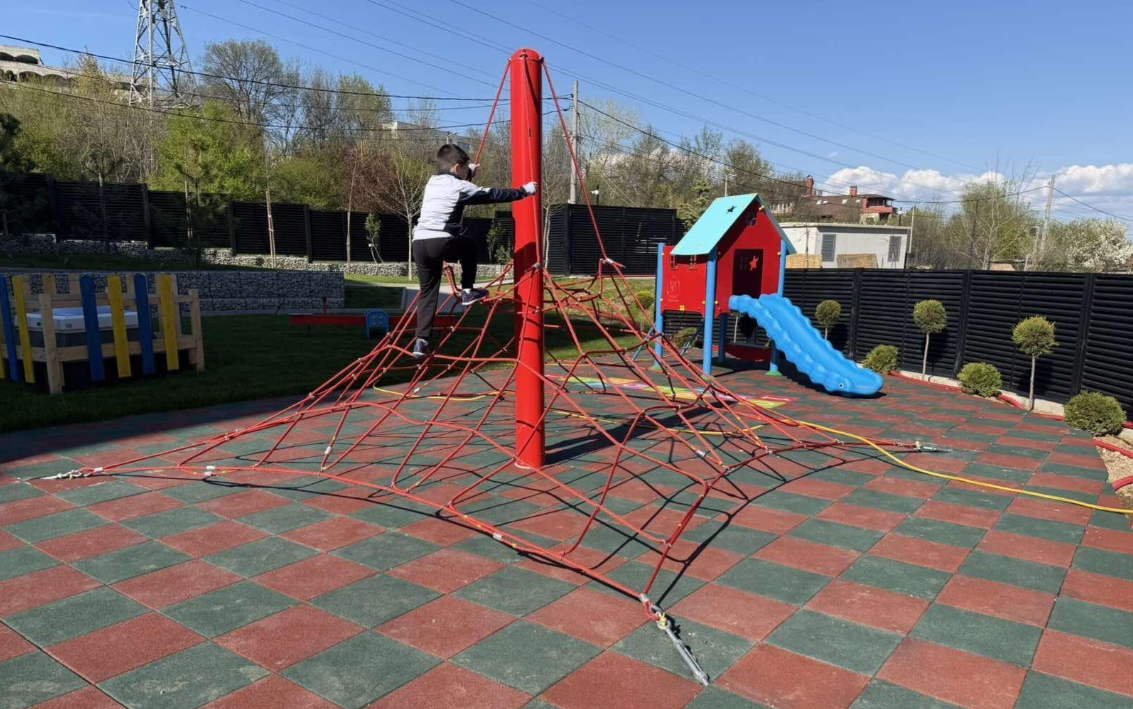
How much does a playground cost in Bulgaria?
When planning a new play space, the question is not just how much a playground costs, but what you actually receive for your budget. For municipalities, schools, hotels, residential complexes, and commercial venues, this is an investment that must perform long‑term — safely, reliably, and with visible value for children, families, and the venue itself.
Costs can vary widely. A small playground with basic elements sits in a completely different range from a themed solution with rope structures, climbing zones, impact‑absorbing surfacing, and custom design. This is why the most accurate answer almost always begins with one clarification — it depends on the scope, the environment, and the expected outcome.
How much a playground costs depending on scale
Broadly speaking, the budget is determined first by the size and complexity of the project. Small play areas with a few combined modules, a swing, and safety surfacing require a noticeably lower investment. For medium and large venues designed to serve higher footfall from children and families, the price increases with added functions, stronger structural requirements, and more complex installation logistics.
As a reference point, a small commercial or residential playground can start from tens of thousands of leva when it includes high‑quality certified equipment and professional installation. A medium‑scale project for a school, hotel, or municipal environment often requires a wider budget range. Large themed spaces with custom design, rope structures, climbing elements, educational zones, and a strong visual identity can increase the investment significantly.
There is an important nuance. A low initial price does not always mean a better deal. If materials are compromised, the structure is not dimensioned for intensive use, or the surfacing is not calibrated for fall height, repair and replacement costs quickly change the picture.
Which factors shape the cost
Size and capacity
A playground designed for 10–15 children is not engineered the same way as a playground intended for active family flow in a resort, a large residential complex, or a city park. The higher the expected capacity, the greater the loads, circulation requirements, and need for multiple play points.
This affects not only the number of structures, but also their placement, safe distances, and the overall engineering logic of the project.
Type of equipment
There is a significant difference between a standard slide module and a complex system with towers, bridges, climbing panels, rope routes, ziplines, or low‑rope elements. Dynamic and visually distinctive structures typically require a higher level of engineering, more specialised manufacturing, and more precise installation.
For rope constructions and climbing solutions, the price is influenced by the type of rope, connectors, load‑bearing system, and long‑term durability in outdoor conditions. For wooden playgrounds, factors include the type of timber, treatment, protection, and the detailing of joints.
Materials and craftsmanship
This is one of the most substantial differences between a budget playground and a premium one. Galvanised and powder‑coated steel, high‑quality timber, HPL panels, durable ropes, and UV‑stable components cost more, but they deliver longer operational life and better performance under load and climate variations.
In public and commercial environments, durability is not a luxury. It is directly tied to operational costs, safety, and the reputation of the venue.
Surfacing and site preparation
Often underestimated, yet this is where a significant part of the budget sits. Impact‑absorbing surfacing must meet specific safety requirements based on the free‑fall height. Choosing between poured‑in‑place rubber, rubber tiles, artificial turf with an underlay system, or loose‑fill materials leads to different costs for delivery, preparation, and maintenance.
If the terrain has slope, poor drainage, or requires additional excavation and concrete work, the budget increases as well. In hotel or urban environments, logistical constraints frequently influence installation costs.
Custom design or standard solution
Standard configurations are typically faster to produce and more predictable in price. A custom project delivers stronger visual impact, better use of space, and the ability for the playground to support a specific concept — natural, educational, adventure‑focused, or brand‑driven.
However, this requires more time for design, engineering coordination, and often specialised manufacturing. For many investors, this is exactly where added value is created, especially when the space needs to differentiate the venue in a highly competitive market.
What is included in the price of a professional playground
When comparing offers, don’t look only at the final number. It’s important to know what is actually included. A professionally structured offer typically covers concept development, design, technical engineering, manufacturing, delivery, installation, and documentation.
For more complex projects, there may also be 3D visualisations, adaptation to the specific terrain, age‑group zoning, accessibility measures, lighting, fencing, shading structures, and thematic elements. If these components are not clearly described, you are comparing numbers — but not equivalent solutions.
It is also worth checking who carries responsibility for coordination. When a single contractor manages the entire cycle — from concept to installation — the risk of inconsistencies, delays, and compromises is significantly lower.
How much a playground costs when you are aiming for long‑term value
Many clients begin with the question of price, but eventually reach the more important one — what the value will be after five or ten years. This is especially relevant for hotels, schools, children’s centres, municipalities, and residential developers, where the playground is part of the overall experience and identity of the place.
A higher‑quality solution usually costs more upfront, but often reduces expenses for repairs, complaints, emergency interventions, and premature replacement. Beyond that, a well‑designed playground attracts more families, increases dwell time, boosts satisfaction, and makes the space more lively and recognisable.
For commercial and tourism venues, this has a measurable effect. For educational and public environments, the benefit is even broader — more movement, social interaction, meaningful developmental play, and better use of shared areas.
Where playground budgets are most often underestimated
One of the typical mistakes is planning a budget only for the equipment, without including surfacing, site preparation, transport, installation, and ongoing maintenance. Another is allocating too small an area — something that looks economical on a drawing but does not function well in real‑world use.
Age‑group zoning is also frequently underestimated. If the playground must serve children of different ages, more careful planning is required, and this affects the types of modules and the safe distances between them. For international, public, and high‑category venues, stricter expectations for visual quality, certification, and execution standards add further complexity.
How to plan a realistic budget
The best approach is not to begin with an arbitrary number, but with a clear purpose. Do you want the playground to be a convenience, a main attraction, or a strong element of the venue’s positioning? The answer determines the scale of the investment.
Next, it is useful to define several parameters: available area, age groups, expected footfall, preferred materials, type of environment, and timeline. When these conditions are clear, the budget range becomes far more realistic.
A professional partner will not give you a universal figure in a minute. They will ask the right questions, assess risks, propose a solution based on your priorities, and show where it is worth investing more — and where optimisation is possible without compromising safety.
This is exactly what distinguishes a well‑managed project from simply purchasing equipment. With companies that operate through a full‑cycle process, such as Edutain Attractions, the value comes not only from the product, but from the way experience, durability, and peace of mind are engineered for the client.
When a higher price is justified
There are situations where a higher budget is entirely reasonable. If the playground is a central part of a hotel’s family experience, a new residential development, a public park, or a school environment with heavy daily use, the investment in a higher‑quality solution becomes visible very quickly.
The same applies when the venue needs a distinctive visual identity. A playground is not just equipment. It can be the reason families choose your location, stay longer, and return again.
If today you are asking how much a playground costs, the most useful answer is the one that connects price with purpose, safety, and the life of the project after opening day. A well‑planned playground is not an expense to simply tick off — it is a space that brings joy, movement, and real long‑term value to the people who use it.
FAQ
1. Why does playground pricing vary so widely?
Because it depends on scope, environment, materials, equipment type, surfacing, terrain, design, and expected usage. A small modular setup and a themed climbing zone are fundamentally different projects.
2. What are typical budget ranges by size?
Small playgrounds → tens of thousands.
Medium projects → broader range depending on features and traffic.
Large themed spaces → significantly higher budgets for ropes, climbing zones, surfacing, and custom design.
3. What factors influence the cost the most?
Capacity, equipment type, materials, surfacing, terrain, logistics, custom design, and installation.
4. Why are materials so important?
Premium materials (steel, HPL, quality timber, UV‑resistant ropes) offer longer lifespan, fewer repairs, and higher safety, reducing long-term costs.
5. How much does safety surfacing cost?
It depends on type: poured rubber, tiles, artificial turf, or loose fill. Surfacing is often a major budget component, especially for higher fall zones.
Maria Mihova
Published on: August 18, 2026 | Last Updated: August 18, 2026Founder & CEO at Edutain Attractions
Maria designs and delivers immersive, educational play experiences for hotels, municipal parks, and resorts worldwide. With over 15 years in international business development and adventure products, she builds play environments that combine safety, learning, and fun. Find out more about me
