
Selecting Shock-Absorbing Surfacing for a Children's Playground
A child steps off a rope structure, jumps from a platform, or loses balance on a climbing element in a fraction of a second. In that moment, the choice of impact‑absorbing surfacing is not a matter of colour or a budget line in the project. It is a key decision for limiting injury risk, ensuring long‑term durability, and maintaining the trust of the families who use the area.
In play areas, surfacing functions as a safety system. It must correspond to the equipment, the possible fall height, the intensity of use, climate conditions, and the way the venue will be maintained over the years. The best solution is rarely simply the softest or the cheapest. It is the one that meets the specific technical requirements of the project and remains reliable under daily use.
Choosing impact‑absorbing surfacing starts with the equipment
The first question is not “Which surfacing do we like?”, but “What risks exist around each piece of equipment?”. Climbing frames, rope pyramids, swings, zip lines, and combined play systems have different fall zones and different critical fall heights. It is the critical fall height that determines the level of impact absorption the surfacing must provide.
Standard EN 1177 defines the methodology for testing the impact‑absorbing properties of surfacing, while EN 1176 covers the requirements for equipment and safety zones. For international venues, other applicable local standards may also be relevant. What matters is that compliance is not assumed from a catalogue or based on visual judgement. It must be confirmed for the specific system — with the chosen material, thickness, base, and installation method.
This is especially important in complex projects. A single play area may include a low zone for younger children, a tall rope structure, and a swing section. They may appear to form one unified space, yet require different surfacing solutions under each element. A single surfacing type everywhere is convenient to install, but not always the most reasonable or effective approach.
Critical fall height is not a formality
Critical fall height indicates the maximum height from which the surfacing can limit the risk of severe head injury during testing. It does not make falling risk‑free, nor does it replace the need for proper design, supervision, and good maintenance. It is a measurable indicator of whether the surface provides the required protective performance for the specific equipment.
Planning must consider more than the height of platforms. Possible fall trajectories, swing dynamics, access points to the structure, and the areas where children actually land all matter. A professional project anticipates these scenarios before installation — not after the first signals from visitors or staff.
Which material is right for your venue?
The material must match the character of the environment. A hotel complex with high expectations for appearance and easy daily maintenance has different priorities from a municipal playground with heavy visitor flow or a schoolyard used intensively throughout the academic year.
Poured rubber surfacing
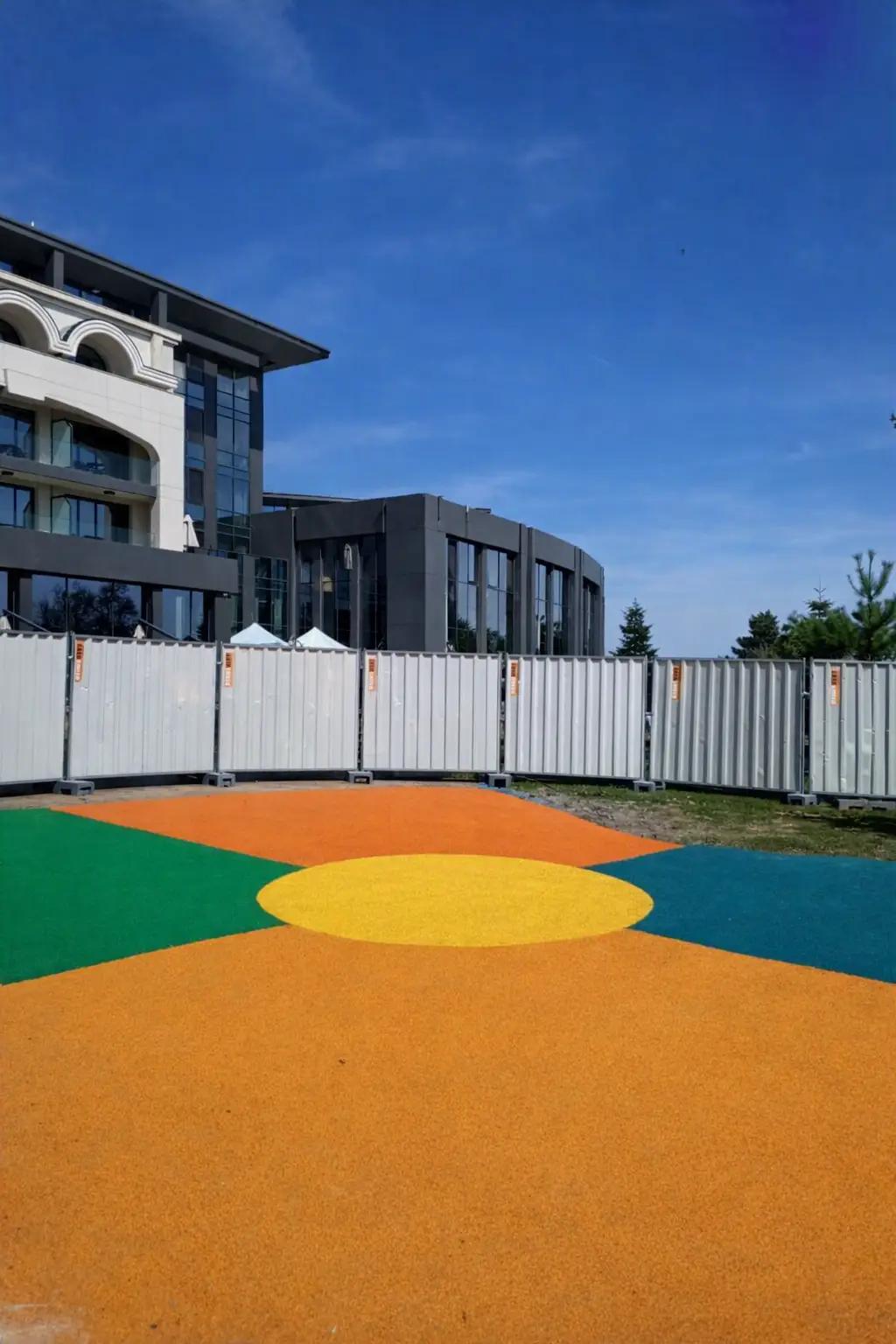
Poured rubber surfacing is often chosen for premium urban, hotel, and commercial spaces. It allows a seamless appearance, colour compositions, graphics, and smooth shaping around play elements. When designed with the correct thickness and installed on a professionally prepared base, it can provide a high level of impact absorption and good accessibility for strollers and wheelchairs.
Its advantage is the controlled, finished look. The trade‑off is that the quality of the base, binder, drainage, and installation is critical. A low initial price for this type of surfacing often signals a risk of cracking, delamination, fading, or compromised performance. For high‑traffic venues, choosing an installer with clear process control is just as important as choosing the material itself.
Rubber tiles
Rubber tiles provide a modular solution with predictable thickness and relatively fast installation. They are practical for smaller zones, for upgrading existing play areas, and for locations where individual sections may need replacement.
The joints, however, require attention. With an unsuitable base, weak adhesion, or temperature‑related movement, they can open and create a tripping hazard. Tiles should not be viewed as an automatically easier option — they also require precise ground preparation and controlled installation.
Loose‑fill materials
Engineered wood mulch, specialised wood fibres, and other certified loose‑fill solutions can be suitable for natural play areas, parks, and spaces with wooden structures. They visually complement the natural environment and are often a good choice for large surfaces.
For these materials, thickness and even distribution are critical. Loose‑fill shifts during play, is carried away by wind, compacts over time, and must be periodically loosened and topped up. This is not a drawback if the operator has a realistic maintenance plan. But if the venue lacks the resources for regular inspections, a seemingly economical solution may lead to uneven surfaces and insufficient protection in the most heavily used areas.
Sand and gravel should not be treated as universal answers simply because they are familiar. Their properties, cleanliness, required depth, and behaviour in humidity must be evaluated specifically. Ordinary grass is also not a certified impact‑absorbing surface under equipment with fall height.
Artificial grass with a protective layer
Artificial grass installed over a suitable impact‑absorbing underlay combines a green aesthetic with a more structured play solution. It is suitable for residential complexes, children’s centres, hotels, and venues where the landscape effect is part of the experience.
Here, the entire system must be evaluated — not just the visible surface. The type and thickness of the underlay, drainage, fixation method, and compliance with the required critical fall height determine real safety. The grass may look excellent on opening day, but its value is proven after seasons of sun, rain, and intensive play.
The base and drainage determine the lifespan of the surfacing
Even the highest‑quality surface cannot compensate for a poorly prepared base. Leveling, load‑bearing capacity, slopes, and drainage must be resolved during the engineering phase. Standing water accelerates wear, creates slippery areas, and can affect the stability of the surfacing.
For outdoor play areas, drainage is a requirement for year‑round use — not an optional extra. In regions with hot summers, surface heating must also be considered. Dark rubber surfacing and artificial grass can reach high temperatures under direct sun. Shade from trees, canopies, or architectural elements improves comfort and makes the zone more attractive during peak sunlight hours.
Plan maintenance from the moment you commission the project
Surfacing does not end with the handover of the site. It must be part of the operational plan of the hotel, school, municipality, or property operator. Daily visual checks identify contamination, sharp objects, displaced loose‑fill material, and visible damage. Periodic, more detailed inspections track joints, wear, drainage performance, compaction, and changes in fall zones.
When commissioning the project, request clear information on warranty conditions, recommended maintenance, expected lifecycle, and the possibility of local repairs. This is especially important for venues with continuous public access, where closing the area carries both reputational and operational risk.
How to make a decision with long‑term value
The right choice combines safety, visual identity, and realistic operation. To compare offers objectively, do not look only at the price per square metre. Compare the scope: base preparation, system thickness, fall‑zone coverage, drainage solutions, installation, documentation, testing, and ongoing maintenance.
In Edutain Attractions projects, surfacing is treated as an integrated part of the play environment, not as the final construction layer. This approach allows structures, movement zones, accessibility, and visual concept to work together. The result is a space where children can be bold and adults can feel at ease.
When choosing surfacing, think about the day after opening: the wet morning, the summer afternoon, the hundreds of small steps, and the children who will return again. The best surface is the one that continues to keep play alive, confident, and joyful.
FAQ
1. Why is surfacing so critical for safety?
Because it is an active safety system that reduces injury risk during falls.
2. What is “critical fall height”?
The maximum height from which the surface can reduce severe head injury risk under EN 1177.
3. Why does selection start with the equipment?
Different structures require different fall zones and different surfacing performance.
4. Which standards apply?
EN 1176 (equipment) and EN 1177 (surfacing), plus local standards for international sites.
5. Is one surfacing type suitable for the entire playground?
Not always — different elements may require different thicknesses and systems.

Maria Mihova
Published on: September 14, 2026 | Last Updated: September 14, 2026Founder & CEO at Edutain Attractions
Maria designs and delivers immersive, educational play experiences for hotels, municipal parks, and resorts worldwide. With over 15 years in international business development and adventure products, she builds play environments that combine safety, learning, and fun. Find out more about me
