
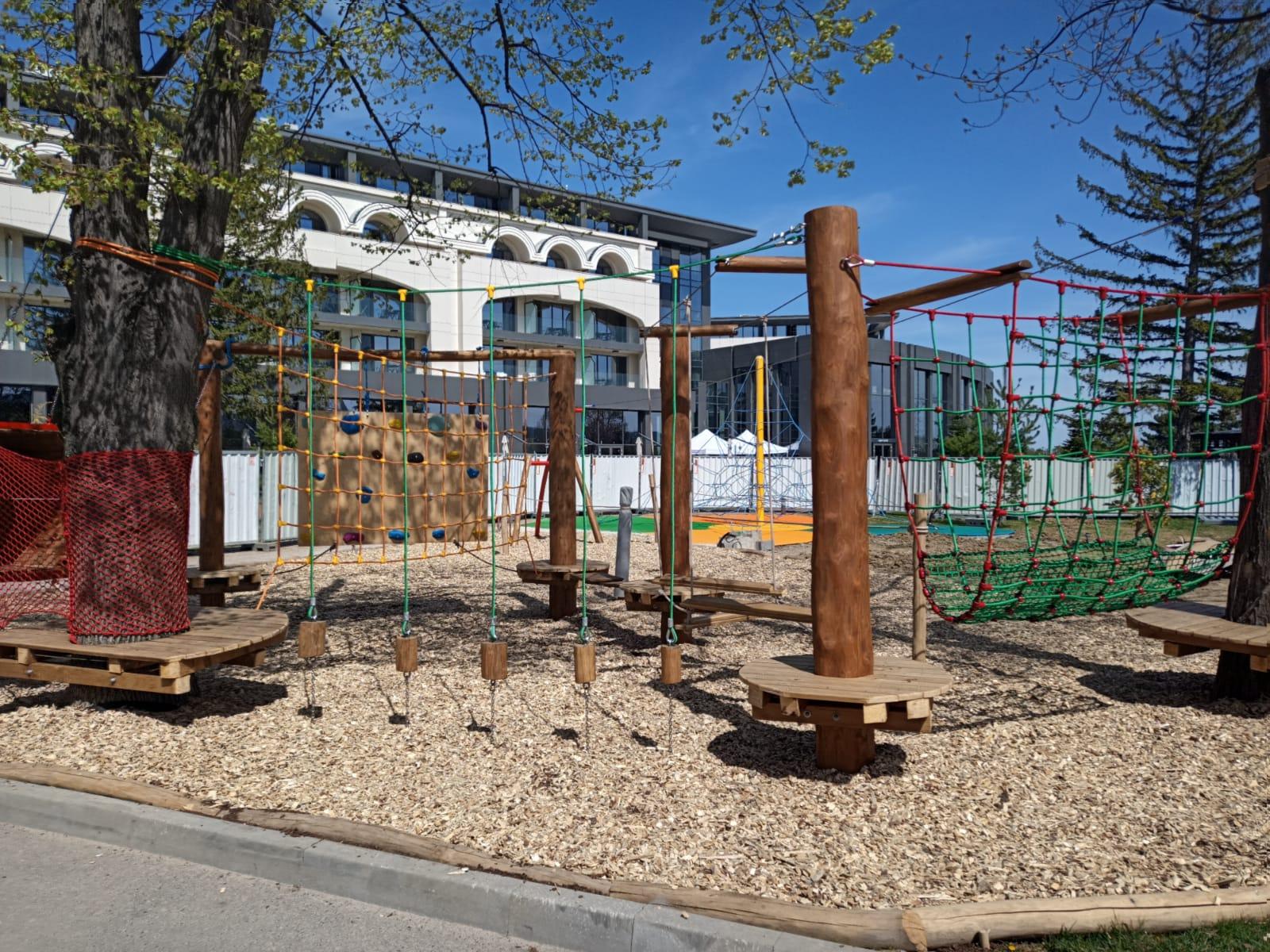
Children's Playgrounds for Hotels That Add Value
Families rarely choose a hotel based solely on room photos. They look for a place that feels convenient, calm, and genuinely enjoyable for children. That’s why hotel playgrounds are not just an add‑on to the garden or the pool — they are part of the entire guest experience. When planned correctly, they help the property stand out, keep guests on‑site longer, and create lasting, positive memories for families.
In hotels, decisions about outdoor and indoor spaces are always evaluated through several lenses at once — safety, durability, ease of maintenance, and real business value. Children’s areas add one more dimension: they must deliver joy, movement, and imagination without compromising the operational logic of the property. This is where the difference becomes clear between a standard playground and a professionally developed concept.
What hotels expect from hotel playgrounds
For a hotel, a playground is not an isolated element. It must work in harmony with the property’s category, guest profile, and overall environment. A seaside resort, a mountain complex, an urban family hotel, and a luxury resort all have different needs — even when they share the same goal: more satisfied families and a stronger product.
The most common mistake is treating the playground simply as a “kids’ corner.” This leads to minimal equipment, weak visual identity, and limited use. A better approach is to view it as an asset that influences hotel choice, post‑stay ratings, and the likelihood of guests returning. When children have a high‑quality place to play, parents feel more comfort and more time for themselves. That is direct value for the guest and indirect value for the operator.
A good playground starts with the right concept
Not every space is suitable for the same solution. Sometimes a compact zone near the restaurant is ideal, giving parents visual control. In other cases, a larger outdoor play world becomes a highlight of the entire property. In bad weather, an indoor kids center can be essential for year‑round usability.
The concept must consider age groups, hotel capacity, intensity of use, and guest flow within the property. It matters whether the zone will be used mainly by children under 5, older children, or mixed groups. It also matters whether the hotel wants quiet play, physical challenge, or a stronger edutainment element that combines movement and learning.
When these questions are clarified early, the project becomes more precise. Over‑investment in unsuitable equipment is avoided — and equally important, so are gaps that become expensive later.
Safety that is planned, not promised
For hotel playgrounds, safety cannot be a marketing claim. It must be embedded in the design, materials, engineering decisions, installation, and future maintenance. A hotel operator is not buying equipment — they are investing in an environment that will handle daily use and must remain reliable over time.
Here, the choice of structure, surfacing, and details matters greatly. Materials must withstand weather, heavy use, and seasonal peaks. Connections, protections, fall heights, and free‑space zones are not details for the final stage — they determine whether the space will feel calm for guests and manageable for the hotel team.
A professional process includes not only design and production but also strict quality discipline. For the investor, this means less risk, better predictability, and clearer control over the final result. When the contractor works with a structured process and certified quality standards, the project gains stability long before installation begins.
Design must work visually and operationally
A beautiful playground attracts attention. A successful playground does more — it fits the hotel’s architecture, supports the brand, and remains functional in daily use. This is especially important for premium and resort properties, where every zone shapes the perception of quality.
Natural materials and wooden structures are often a strong choice for nature‑oriented hotels because they bring warmth and harmony. Rope structures, climbing elements, and low rope courses add movement and adventure without requiring a large footprint. For indoor spaces, more compact but highly recognizable solutions can be developed that work in any weather.
There is an important balance here. The more striking an installation is, the more carefully capacity, age suitability, and supervision must be managed. Not every attraction is right for every hotel. Sometimes the smarter solution is a smaller but excellently executed zone rather than a crowded mix of elements without clear logic.
Where a playground delivers the most value
The strongest hotel projects use the playground as part of the overall guest journey. If the zone is near the restaurant, it improves family comfort during meals. If it is positioned near a garden or relaxation area, it becomes a natural social hub. If integrated with animation, sports, or themed activities, it extends the stay and enriches the program.
The benefit is not only emotional. Family guests often evaluate child‑friendly amenities very concretely when choosing a hotel. A well‑executed playground improves the property’s performance with this segment, strengthens recommendations, and reduces the feeling that children must be constantly “entertained” outside the hotel. This is especially valuable for vacation complexes where stays are longer and on‑site variety has direct commercial value.
How to choose the right execution partner
For hotel operators, the safest approach is to choose a partner who can handle the entire cycle — from concept and design to production, delivery, and installation. The reason is simple: when stages are split between multiple suppliers, the risk of compromises, delays, and inconsistencies increases.
A good contractor asks the right questions from the start: What is the guest profile? What is the seasonal load? What are the site conditions? What maintenance can the hotel realistically provide? How will the playground look after two, five, or ten years? These questions separate short‑term solutions from sustainable investments.
Edutain Attractions works exactly in this model — with a full process, premium execution, and a focus on safe, active, and visually distinctive play environments. For the investor, this means a clearer path from idea to real‑world operation.
Outdoor or indoor — it depends on the property model
Many hotels begin by asking whether to build an outdoor playground, an indoor kids center, or a combination of both. The answer depends on climate, seasonality, available space, and guest expectations. In seaside and mountain resorts, outdoor zones are almost always a strong asset, but if there is a long off‑season or frequent weather changes, an indoor solution provides continuous value.
A combined model is often most effective for larger properties. Outdoors, children get movement, energy, and connection with the environment. Indoors, a backup scenario is created for play, calmer activities, or themed programs. This requires more investment and coordination, but with proper planning, the return comes through stronger family appeal and better year‑round usage.
Maintenance is part of the value, not an afterthought
Even the best project loses value if maintenance is underestimated. Hotel environments are dynamic — high usage, diverse age groups, weather exposure, and operational staff who are not always specialized in this area. Solutions must be designed with real‑world operation in mind.
This includes inspection access, durable coatings, reliable components, and clear guidelines for periodic checks. For the operator, it is not enough to have a playground — it must be a playground that maintains its appearance and function with a reasonable maintenance effort. This is where initial quality often proves more cost‑effective than a cheap alternative.
A hotel that invests in a well‑designed children’s zone is not adding just another service. It is showing care for the family experience, for safety, and for those small moments of joy that make guests leave with a desire to return.
FAQ
1. Why is a hotel playground a strategic asset, not just a “kids’ corner”?
Because it directly influences hotel selection, family comfort, length of stay, and guest return rates. A well‑designed playground is an asset, not an expense.
2. What makes a professionally designed playground different from a standard one?
A professional concept considers age groups, capacity, usage intensity, climate, guest flow, and visual identity. Standard setups are often minimal and underused.
3. How is safety ensured in hotel playgrounds?
Safety is engineered — through materials, structures, surfacing, technical design, installation, and maintenance, not through marketing claims. Hotels invest in an environment that must remain reliable for years.

Maria Mihova
Published on: June 23, 2026 | Last Updated: June 23, 2026Founder & CEO at Edutain Attractions
Maria designs and delivers immersive, educational play experiences for hotels, municipal parks, and resorts worldwide. With over 15 years in international business development and adventure products, she builds play environments that combine safety, learning, and fun. Find out more about me
