
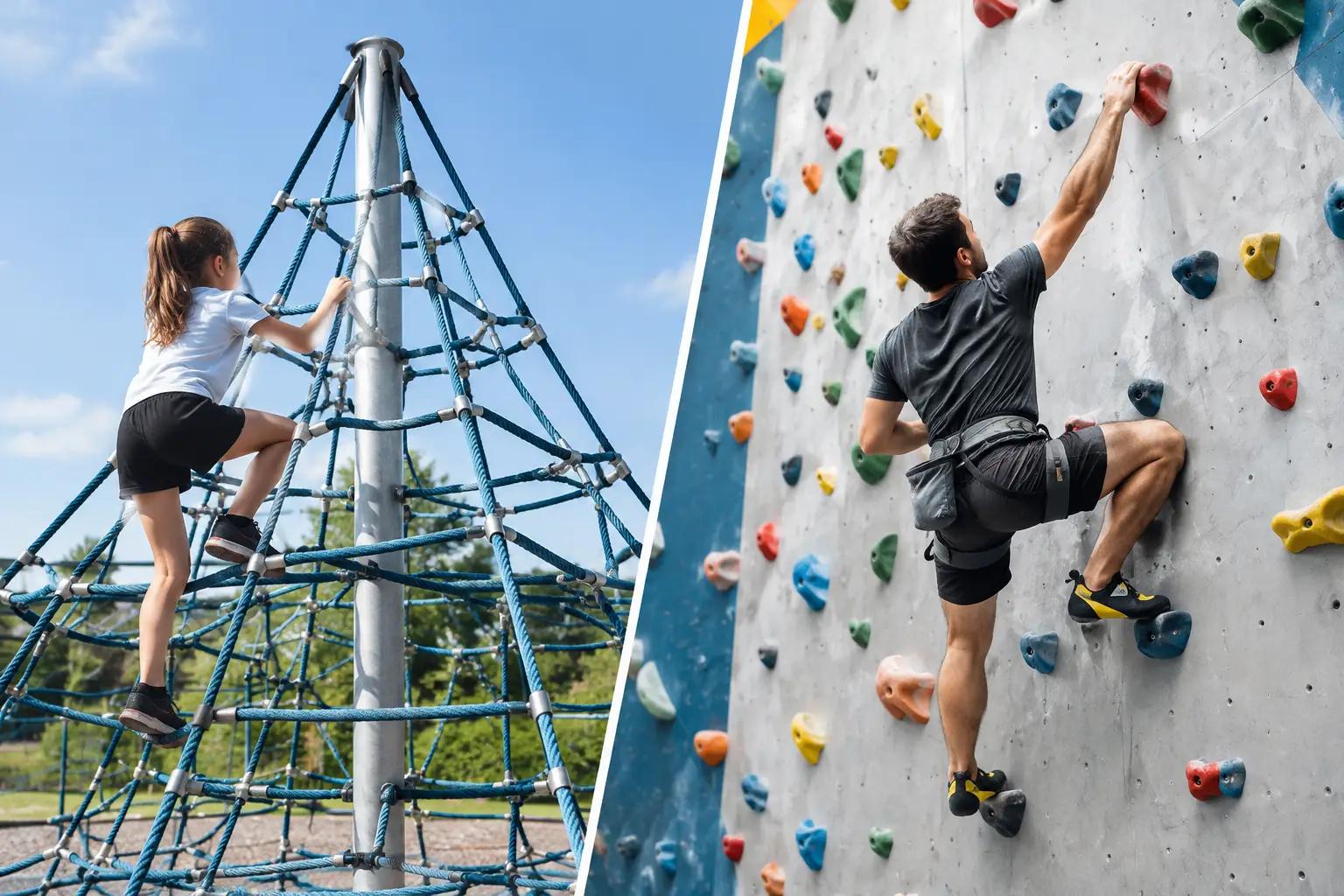
Rope Pyramid vs. Climbing Wall
An unused space in a hotel courtyard, a school campus, or a residential complex can become either an ordinary playground or a reason for families to return. When comparing a rope pyramid and a climbing wall, there is no universal winner. The right choice depends on the age of the children, the available area, the desired experience, the level of use, and how the attraction integrates into the overall environment.
For investors, the question is not simply which structure looks better in a rendering. The real question is which one will perform successfully every day: attracting children with different abilities, handling intensive use, remaining easy to supervise, and creating value for visitors for years to come.
Expert Insight
Choosing between a rope pyramid and a climbing wall is not about selecting the structure that looks more impressive. The best solution is the one that matches the children's age group, available space, expected capacity, and the objectives of the specific project.
Rope Pyramid vs Climbing Wall: Different Experiences
A rope pyramid is a social play structure. Children move in multiple directions at the same time, choose their own routes, wait for one another, pass each other, and naturally help one another. It encourages free play, balance, coordination, and confidence. For older children, reaching the highest point creates a sense of adventure, while for younger children the lower levels offer a gradual introduction.
A climbing wall presents a different kind of challenge. It is more structured: the route is visible, the next hold becomes a clear target, and progress is immediately measurable. This makes it particularly effective for developing concentration, movement planning, strength, and perseverance. Well-designed climbing walls can provide easy routes for beginners and more demanding routes for experienced climbers within the same installation.
This distinction is important when planning the play environment. A rope pyramid creates a central hub for group play. A climbing wall promotes focused activity and often appeals to children motivated by personal achievement. In many projects, the best answer is not choosing one attraction over the other, but creating a thoughtful combination when space and budget allow.
Comparison Between a Rope Pyramid and a Climbing Wall
| Criteria | Rope Pyramid | Climbing Wall |
|---|---|---|
| Play Style | Free and social play | Individual challenge |
| Skill Development | Balance and coordination | Concentration and strength |
| Capacity | Many children simultaneously | More limited |
| Required Space | Larger footprint | More compact |
| Best Environment | Parks, resorts, public spaces | Indoor centers, schools, restaurants |
When a Rope Pyramid Is the Better Choice
A rope pyramid performs exceptionally well in open spaces with good visibility from all sides. It has a strong visual presence and can become a recognizable landmark within a park, resort, large residential complex, or public area. Its vertical design uses height efficiently but requires sufficient clearance around the structure and properly designed impact-absorbing surfacing.
This attraction is particularly valuable when the goal is to increase the amount of time families spend on site. While children explore different levels and routes, parents can comfortably supervise from the perimeter. When properly sized, multiple children can use the structure simultaneously without constant waiting.
For municipalities and property developers, rope structures also provide significant architectural value. They give character to spaces that might otherwise remain visually anonymous. However, a larger pyramid is not always the better solution. An oversized structure in a small area can dominate the environment, limit other play opportunities, and create impractical safety-zone requirements.
Advantages of a Rope Pyramid
- Allows many children to play at the same time.
- Encourages social interaction.
- Creates a strong visual landmark.
- Develops balance and coordination.
- Ideal for larger outdoor environments.
Age Group and Challenge Level
A rope pyramid is most effective when serving mixed-age groups, typically children of preschool and school age. The height, mesh dimensions, rope density, and access to the first levels should be determined by the primary users rather than visual impact alone.
For locations predominantly used by younger children, low rope elements, rope nets, and balance courses are often more appropriate than a tall pyramid. They retain the developmental benefits while providing a safer and more accessible introduction.
When a Climbing Wall Has the Advantage
A climbing wall is a sensible choice when space is limited or when the project has a sturdy vertical surface. It is extremely effective for indoor children’s centers, restaurants with play areas, retail locations, hotels, and schools, where floor space is a valuable resource. Instead of taking up a large horizontal area, the wall transforms a facade, partition, or specially built structure into an active play feature.
For operators of indoor spaces, this also offers the opportunity for year-round activity. Outdoor attractions are a major asset, but weather and seasonality limit their use. The climbing wall keeps children active and energized in a controlled environment, even during periods of rain or high temperatures.
The wall can be discreetly integrated into the interior or serve as a major visual focal point. Thematically designed panels, colorful routes, and three-dimensional features spark the imagination without distracting from safe climbing. In an educational setting, it can be part of a motor skills development program, and in a hotel or shopping center, it can serve as a distinctive feature of the family area.
Flow Control and Supervision
With a climbing wall, movement is typically easier to organize and manage. Children start from a designated area, climb along a clearly defined surface, and return safely to ground level. This provides an advantage for facilities that employ supervisors, run organized activities, or need to manage a high volume of visitors.
However, not every climbing wall is equally suitable for free play. For taller systems, designers must consider the belay method, user access, training requirements, and the level of supervision required. For family-oriented spaces with short visitor stays, low bouldering walls with engineered fall zones and impact-absorbing surfacing are often the most practical solution. They allow independent yet controlled challenges.
Advantages of a Climbing Wall
- Ideal for compact spaces.
- Makes efficient use of vertical surfaces.
- Develops concentration and movement planning skills.
- Provides year-round activity indoors.
- Allows better visitor flow management.
Space, Surfacing, and Safety
Safety is not an additional layer applied after the design phase. It is the starting point of every decision. For rope pyramids, designers must evaluate free-fall height, safety zones, rope tension, anchoring methods, foundations, access points, and visibility for parents and supervisors. For climbing walls, the supporting structure, panel geometry, climbing holds, route layout, landing zones, and user access methods are key considerations.
Surfacing should never be selected based solely on color or cost. It must correspond to the specific fall height and type of use while remaining resistant to climate conditions, wear, and intensive cleaning. Properly designed surfacing also improves accessibility and enhances the overall perception of quality.
Professional design is equally important for details that visitors never see: material durability, corrosion protection, reliable connections, drainage systems, foundations, and precise installation. Working within an ISO 9001:2015 quality-management framework brings discipline to the process, but every project must also comply with applicable local regulations and safety standards.
Key Safety Factors
| Element | Rope Pyramid | Climbing Wall |
|---|---|---|
| Fall Zone | Large perimeter safety area | Concentrated landing zone |
| Main Structure | Ropes and support frame | Panels and load-bearing structure |
| Surfacing | Impact-absorbing surfacing | Impact-absorbing surfacing |
| Supervision | Panoramic visibility | Focused supervision |
| Maintenance | Ropes and tension systems | Holds and climbing panels |
Maintenance and Long-Term Value
Both solutions require planned maintenance. For rope structures, regular inspections focus on the condition of ropes, connectors, tensioning systems, and support components. For climbing walls, inspections include panels, holds, fixings, landing surfaces, and any safety systems that may be installed.
For B2B and public-sector investors, the lowest initial price is rarely the most cost-effective option. Materials with limited durability, poor documentation, or compromised installation quality can result in more closures, repairs, and loss of trust among visitors. Premium execution protects not only the equipment itself but also the reputation of the facility.
When planning the project, consider future development as well. Will there be room in two years for a low ropes course, a swing, a toddler area, or themed additions? A modular approach can transform the initial investment into the foundation of a larger and more engaging play environment.
Long-Term Investment Value
| Criteria | Rope Pyramid | Climbing Wall |
|---|---|---|
| Architectural Impact | Very High | Medium to High |
| Capacity | High | Medium |
| Design Flexibility | Good | Excellent |
| Expansion Potential | Yes | Yes |
| Suitable for Indoor Areas | Limited | Excellent |
Expert Recommendation
If the objective is social play, high capacity, and a strong visual landmark, a rope pyramid is generally the superior solution. If space is limited and the goal is to provide a structured climbing experience with better visitor-flow control, a climbing wall often delivers greater operational efficiency.
How to Make the Right Decision
If you are looking for an iconic outdoor attraction with high capacity and strong social play value, a rope pyramid is usually the better choice. If you have limited space, need an indoor activity, or want a clearly structured climbing experience, a climbing wall offers significant practical advantages.
Before finalizing your brief, define four important factors: the primary age group, the number of children expected during peak periods, the level of supervision you can realistically provide, and the role the attraction should play within the facility. These answers are often far more valuable than any product catalog comparison.
The most successful play environments do more than encourage children to climb. They provide opportunities to try again, recover from failure, and discover that the next step is achievable. When the structure is chosen carefully and professionally implemented, that confidence remains long after playtime has ended.
Frequently Asked Questions
Which option is better for a hotel or resort?
A rope pyramid is generally more suitable for large outdoor spaces and high visitor volume, while a climbing wall works exceptionally well in limited spaces or indoor family areas.
Which attraction allows more children to play simultaneously?
In most cases, the rope pyramid offers a higher capacity and allows multiple children to play at the same time.
Is a climbing wall safer?
Both solutions can be extremely safe when professionally designed, properly installed, and combined with appropriate impact-absorbing surfacing.
Which option requires less space?
A climbing wall generally requires less horizontal space because it uses vertical surfaces more efficiently.
Can both attractions be combined?
Yes. In many modern playgrounds and adventure areas, rope pyramids and climbing walls are combined to create a richer and more diverse play experience.

Maria Mihova
Published on: November 10, 2026 | Last Updated: November 10, 2026Founder & CEO at Edutain Attractions
Maria designs and delivers immersive, educational play experiences for hotels, municipal parks, and resorts worldwide. With over 15 years in international business development and adventure products, she builds play environments that combine safety, learning, and fun. Find out more about me
