
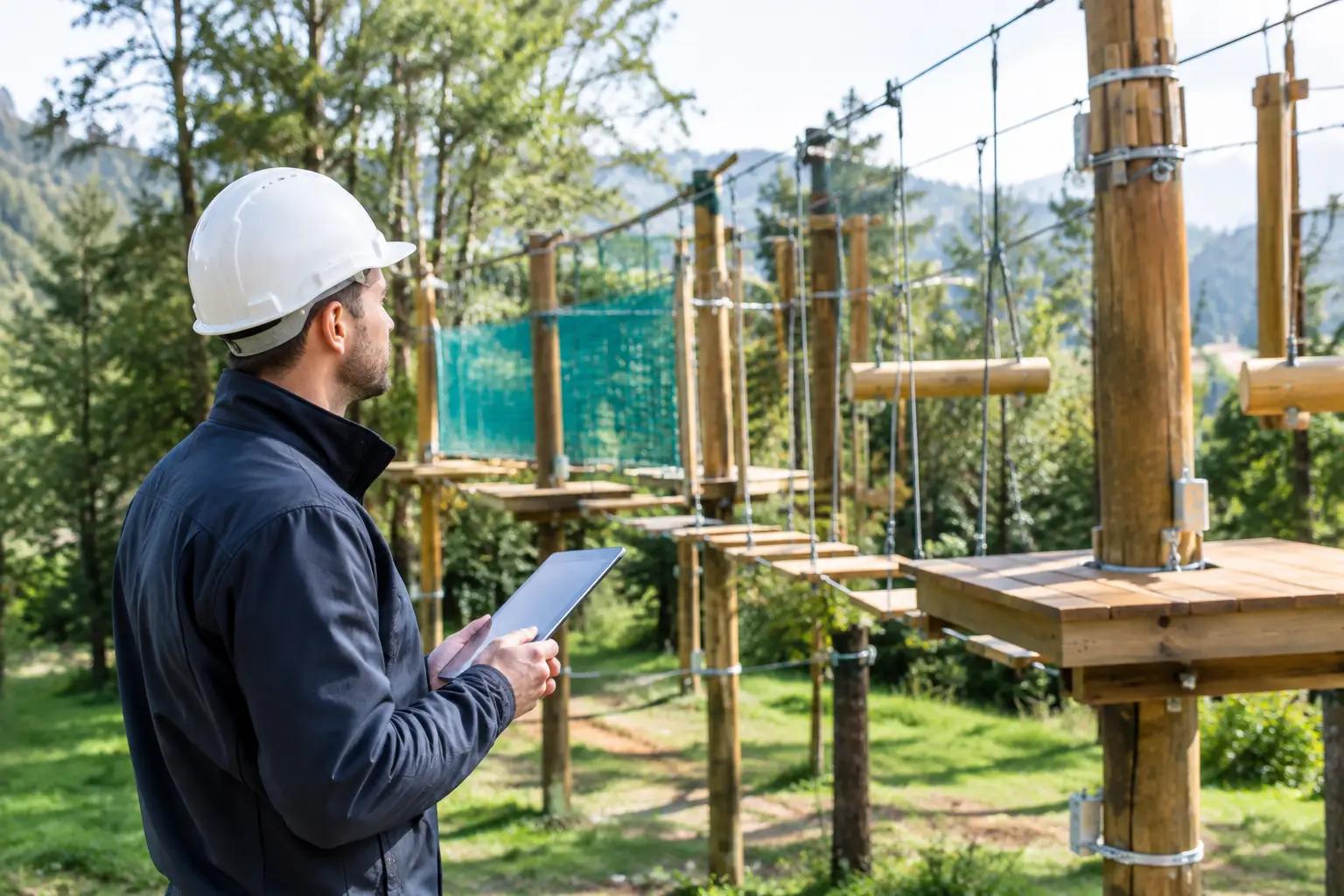
How to Choose a Low Ropes Course for a Project
An open grassy area beside a hotel, a school courtyard, or a quiet zone within a shopping center can become a place that encourages children to move, interact, and return again and again. The question of how to choose a low ropes course does not begin with selecting rope elements. It starts with a clear understanding of who will use the space, how it will function every day, and what value it should create for the property.
A low ropes course is a low-height rope-based challenge course featuring balancing, climbing, and transitional elements positioned close to the ground. It promotes coordination, confidence, and teamwork without requiring a tall structure. For operators, it represents an opportunity to add a distinctive family attraction that activates underutilized space and encourages longer visitor stays.
Expert Insight
The most successful low ropes courses are not defined by the number of obstacles they contain. Their true value comes from how well they meet the needs of the facility, the expectations of visitors, and their ability to provide a safe and engaging experience for different age groups.
Start with the Role of the Course Within the Facility
The best course is not necessarily the one with the greatest number of obstacles. It is the one that fulfills a specific purpose. In a hotel or resort, a low ropes course can become a natural center for family activities between the pool and the restaurant. In a school or kindergarten, it can support daily active play and motor-skill development. In a residential complex, it creates a reason for families to spend more time in shared spaces.
Define the outcome you expect from the beginning. Are you looking for a compact free-play area, a more challenging route for older children, or a visual centerpiece that distinguishes the entire project? The answer will influence the scale, complexity, budget, and required capacity.
It is also useful to consider how the course will be used. A course next to a restaurant is often visited in short bursts, while an attraction in a resort may operate intensively for long hours during peak seasons. In schools, usage is concentrated during breaks and holidays. The structure, surfacing, and overall layout should be designed for real usage patterns rather than assumptions.
Key Planning Factors
| Factor | Why Is It Important? |
|---|---|
| Visitor Profile | Determines the difficulty level and course layout |
| Available Space | Influences the scale and route design |
| Expected Capacity | Prevents overcrowding and waiting times |
| Investment Objective | Defines the project's direction |
| Maintenance Requirements | Affects future operating costs |
How to Choose a Low Ropes Course Based on the Users
The age and physical abilities of children are the primary filter when selecting a course. An element that is exciting for an eight-year-old may be too difficult for a four-year-old. The opposite is also true: a configuration that is too easy quickly loses its appeal for older users.
For mixed-age groups, the best approach is to create a course that offers different challenge levels within a single composition. Low balance beams, stable stepping elements, and wide rope nets provide a confident starting point. More dynamic transitions, rope bridges, and swinging elements add difficulty for children with more experience. This allows siblings to play close to one another without having exactly the same experience.
Do not overlook the role of adults. In family-oriented venues, parents should be able to comfortably supervise children from seating areas or nearby terraces. Good visibility improves supervision and creates peace of mind. For organized groups, it is important to provide adequate waiting areas without interrupting the active route.
Best Practices for Design
- Different levels of difficulty for different age groups.
- Easy entry-level elements for younger children.
- More challenging obstacles for older children.
- Clear visibility for parents and staff.
- Dedicated waiting areas for organized groups.
Select the Site Before Choosing the Elements
The site influences far more than the course layout. Its dimensions, slope, drainage conditions, installation access, and proximity to existing facilities should all be assessed before design begins. In many cases, a compact configuration with carefully selected elements performs better than a stretched route that forces visitors into inconvenient circulation patterns.
For outdoor spaces, consider sunlight, wind exposure, and water accumulation after rainfall. Tree shade is valuable during summer, but the root system, branches, and maintenance requirements must be evaluated professionally. If the site is located in a coastal, mountain, or high-sun-exposure environment, materials and protective finishes should be selected according to local conditions.
Access also has practical importance. Large modules can reduce installation time but require sufficient delivery and positioning access. In difficult-to-reach courtyards or rooftop terraces, modular systems are often the more practical solution. They allow precise adaptation to limited spaces but should be designed as an integrated system rather than a collection of unrelated elements.
Safety Is a System, Not a Single Component
A low installation height does not eliminate the need for careful engineering and planning. The safety of a low ropes course depends on the combination of the supporting structure, ropes, connection details, clear safety zones, appropriate impact-absorbing surfacing, and a well-defined circulation route.
High-quality materials are an investment in fewer operational interruptions and a better user experience. Weather-resistant ropes, protected metal components, and durable connections help the course maintain its appearance and functionality under regular use. Natural timber can add warmth and character to the environment but requires proper treatment and planned maintenance. Steel structures offer a different visual and structural approach. The choice depends on the property's architecture, climate, and desired long-term appearance.
Ask the manufacturer how safety zones are determined, what inspections are performed before project handover, and what operational guidance is provided to the on-site team. Certified quality management systems, including ISO 9001:2015, are useful indicators of discipline in design, production, and quality control. However, they do not replace a technical evaluation of the specific configuration and site conditions.
Expert Recommendation
The safest low ropes courses are designed as complete systems where the structure, ropes, surfacing, circulation route, and supervision work together rather than functioning as separate components assembled in one location.
Key Safety Factors
| Element | Purpose |
|---|---|
| Impact-Absorbing Surfacing | Reduces the risk of injuries from falls |
| Safety Zones | Provide adequate clearance around obstacles |
| Durable Materials | Ensure a long service life |
| Regular Inspections | Maintain the course's safety performance |
| Clear Route Layout | Supports safe movement between elements |
Design for Capacity, Not Just Visual Impact
A visually impressive course attracts attention, but a narrow route can create queues during peak periods. Capacity depends on the number of children using the course at the same time, the duration of the route, the number of entry and exit points, and the availability of overtaking opportunities or alternative paths.
For hotels and resorts, it is wise to consider morning, afternoon, and evening peak periods. For municipal facilities, weekends and school holidays are often the busiest times. If the area is intended for organized groups, wider platforms and route branches can help reduce waiting times and provide instructors with better control.
A good layout also incorporates moments of rest. Small platforms, calm rope nets, and low-level elements allow children to regulate their pace naturally. This makes the experience more inclusive and reduces pressure on high-traffic sections of the course.
Capacity Planning Checklist
| Factor | Impact on the User Experience |
|---|---|
| Number of Active Children | Determines route width and organization |
| Entry and Exit Points | Reduce congestion |
| Alternative Routes | Provide different difficulty levels |
| Rest Areas | Make the course more inclusive |
| Peak-Time Analysis | Improves long-term usability |
Look for a Design That Supports the Brand and the Location
A low ropes course should never look like a product that was added at the last minute. It can reflect the history of the location, the surrounding environment, or the architectural language of the project. Nautical themes are ideal for coastal hotels, nature-inspired forms suit parks and eco-resorts, while cleaner geometric designs work well in modern residential developments.
A theme adds value when it supports play rather than getting in the way. Colors should be recognizable without creating visual clutter. Details can stimulate imagination by encouraging children to cross an "expedition" route or balance on a "forest" bridge while maintaining the functional clarity of the course.
This is where custom design delivers the greatest value. A team experienced in concept development, engineering, manufacturing, and installation can align the vision with the actual limitations of the site.
Benefits of Custom Design
- Highlights the property's identity.
- Improves visitor recognition and engagement.
- Adapts to the unique characteristics of the site.
- Creates a unique experience for families.
- Adds long-term value to the investment.
Calculate the Lifecycle Cost, Not Just the Initial Price
Comparing offers solely on their initial price often leads to costly decisions in the long run. A lower price may result in a shorter service life, more frequent replacement of components, or uncertainty regarding who is responsible for installation and future inspections.
Ask for a clear scope of services: Does the proposal include design, engineering drawings, delivery, foundation preparation, installation, final inspection, and maintenance documentation? It is equally important to understand how spare parts are handled and what is expected from the facility's staff after the attraction opens.
Planned preventive maintenance is part of quality operations. Regular visual inspections, seasonal reviews, and timely responses to wear and tear protect both the investment and the trust of families.
Material Comparison
| Material | Advantages | Considerations |
|---|---|---|
| Natural Timber | Warm appearance and natural character | Requires periodic maintenance |
| Steel | High strength and long lifespan | Requires corrosion protection |
| Hybrid Systems | Balance between design flexibility and durability | Require a tailored project approach |
When a course is selected with children, the location, and everyday operation in mind, it becomes much more than an attraction. It gives every child a reason to try once more, find balance, and share the joy of movement with others.
Frequently Asked Questions
What is a low ropes course?
A low ropes course is a ground-level challenge route featuring balancing, climbing, and transitional elements designed to develop coordination, confidence, and teamwork skills.
What age groups is it suitable for?
That depends on the design. A well-planned course can offer different levels of difficulty for various age groups.
What is the most important factor when choosing a low ropes course?
The user profile, available space, project objectives, safety requirements, and expected capacity are the primary factors that should be evaluated before selecting specific elements.
Can the course be customized?
Yes. A custom-designed course can be adapted to the architecture, theme, and functional requirements of a specific project.
Why is lifecycle cost more important than the initial price?
A lower purchase price often leads to higher maintenance costs, a shorter service life, and more frequent replacement of components over time.

Maria Mihova
Published on: November 3, 2026 | Last Updated: November 3, 2026Founder & CEO at Edutain Attractions
Maria designs and delivers immersive, educational play experiences for hotels, municipal parks, and resorts worldwide. With over 15 years in international business development and adventure products, she builds play environments that combine safety, learning, and fun. Find out more about me
