
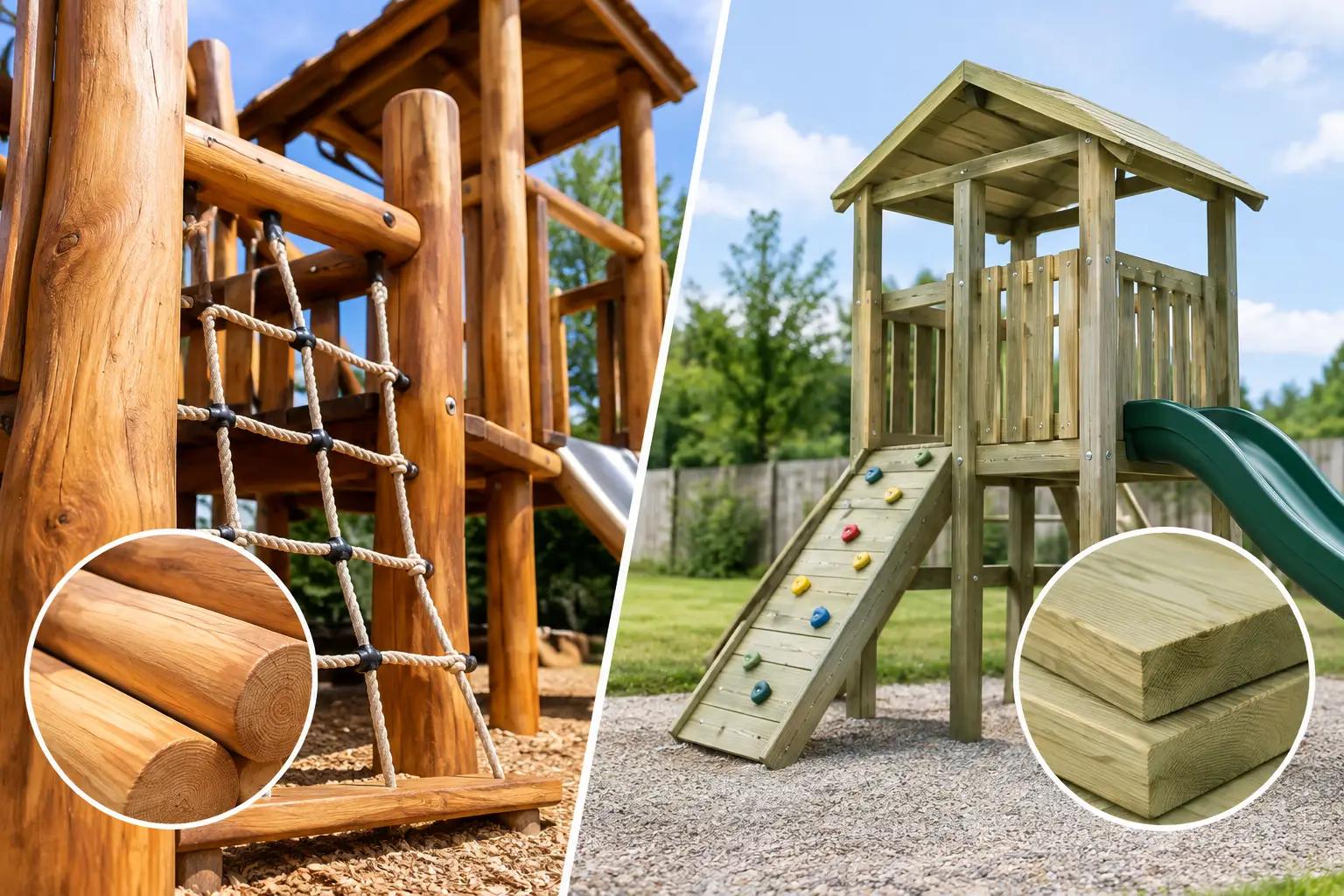
Robinia vs. Impregnated Pine for Children's Playgrounds
When planning a playground for a hotel, school, residential complex, or municipal park, the choice of timber affects far more than the final appearance. The question of robinia versus pressure-treated pine impacts the investment, safety, maintenance schedule, and the overall experience the space creates for children and their families. Both materials can be the right choice. The decision depends on the environment, the intensity of use, and the value the playground is expected to deliver over the years ahead.
In premium projects, wood is more than just a structural material. It is part of the experience: warm to the touch, naturally suited to park environments, and expressive enough to turn a play area into a distinctive feature of the property. However, an attractive appearance only matters when it is supported by proper engineering, quality processing, and professional installation.
Robinia vs. Pressure-Treated Pine: The Main Difference
Robinia, often referred to as black locust, is a hardwood with high natural resistance to moisture, decay, and biological pests. In playgrounds, it is recognizable by its organic, slightly irregular forms that preserve the natural character of the wood. This makes it particularly suitable for natural playgrounds, adventure trails, parks, and hospitality developments with a landscape-focused design concept.
Pressure-treated pine is a softwood that has been treated under pressure with a protective preservative. Pine itself does not possess the natural durability of robinia, but high-quality pressure treatment significantly improves its performance in outdoor environments. It is typically supplied in standardized dimensions, with a smoother surface and more predictable geometry.
The difference is not simply “natural versus treated” timber. Robinia relies primarily on its own natural characteristics, while pine depends more heavily on the quality of selection, drying, processing, treatment, and protection of exposed cuts after installation.
When Robinia Is the Better Choice
Robinia is an excellent option when a playground needs to be durable, visually distinctive, and naturally integrated into its surroundings. It is particularly valuable for outdoor locations with high visitor numbers, where the equipment becomes a permanent part of the public landscape. Its curved posts and unique wood grain allow every structure to have its own identity rather than appearing mass-produced.
For children, this type of environment often feels more adventurous. Low rope elements, balance trails, towers, and bridges built from robinia can evoke the feeling of a forest, a castle, or an explorer’s route. This is more than a visual effect. Natural forms encourage imaginative play and create spaces where movement becomes part of a story.
Robinia also offers practical advantages for elements positioned close to the ground or exposed to ongoing moisture. Even so, it does not eliminate the need for proper engineering. The wood may develop cracks, change color under sunlight, and display natural variations. These characteristics should be anticipated during the design phase rather than treated as defects after installation.
The cost is generally higher, both for the material itself and for processing and manufacturing. This is a sensible investment when architectural value, a long service life, and a natural appearance are key project priorities. For a smaller site with a limited budget, however, the higher initial investment may not be the most efficient solution.
Where Pressure-Treated Pine Has the Advantage
Pressure-treated pine is a practical option for projects where precise geometry, a clearly defined budget, and the efficient construction of a larger system are important. It performs well in traditional towers, platforms, fencing, shade structures, educational panels, and modular playground systems with precise dimensions.
The straight profiles make it easier to integrate metal connections, rope nets, slides, and other standardized components. For schoolyards, kindergartens, and residential developments, this often means strong functionality within a carefully managed budget. The material also allows for a consistent visual appearance across different areas of the site.
Its advantage in initial cost, however, should not be viewed in isolation. To achieve a long service life, pine requires proper pressure treatment, reliable water-drainage details, and periodic inspections of coatings, cracks, and areas around fasteners. If the structure retains water or exposed timber ends are not properly protected, deterioration will occur more quickly regardless of the material’s original quality.
The type of preservative used is equally important. In children's environments, timber should be selected with suitable treatment for outdoor use and supported by clear manufacturer documentation. The decision should not be based solely on the color of the wood. A greenish or brownish tint alone does not prove either the depth of treatment or the quality of execution.
Comparison Based on the Criteria That Matter
| Criteria | Robinia | Pressure-Treated Pine |
| Outdoor Durability: | Very high naturally | High with quality treatment and maintenance |
| Appearance: | Organic, natural, distinctive | Uniform, structured, more standardized |
| Initial Investment: | Usually higher | Usually more affordable |
| Maintenance Requirements: | Lower, but not maintenance-free | More significant and regular |
| Best Suited For: | Natural, themed, and landmark projects | Modular, structured, and budget-balanced solutions |
The table provides a useful starting point, but it does not replace a project-specific assessment. A coastal hotel, a mountain resort, and an urban playground beneath dense shade each create different demands in terms of detailing, foundations, and inspection schedules. Usage intensity is equally important. Equipment in a seasonal restaurant play area operates under very different conditions than a central municipal playground used daily by dozens of children.
Safety Begins with the Details, Not the Type of Wood
Whether the chosen material is robinia or pressure-treated pine, a safe playground is defined by the entire system. Structural dimensions must be appropriate for anticipated loads, connections must be protected and correctly positioned, and surfaces must be finished in a way that reduces the risk of splinters and sharp edges. Fall zones, surfacing, accessibility, and visibility for supervising adults are just as important as the timber itself.
Best practice involves treating design, manufacturing, and installation as a single responsibility. When different parties supply materials, build foundations, and assemble equipment without coordination, the risk of compromise increases. For B2B and B2G clients, this is a key reason to work with a contractor who manages the entire process and applies consistent quality procedures, including ISO 9001:2015 standards.
After the playground opens, a plan for periodic inspections is essential. These inspections are not a sign that the material is unreliable. They are part of the responsible management of an asset actively used by children. Fasteners, moving components, timber condition, surfacing, and clear spaces around the equipment should all be checked regularly.
How to Choose for Your Specific Project
Do not begin with the question, “Which wood is better?” Instead, ask, “What should this space achieve?”
If the goal is to create a memorable natural playground that distinguishes a resort, park, or residential project, robinia often justifies the investment. If the goal is a functional, clearly structured play area with an optimized initial budget, pressure-treated pine can provide an excellent foundation.
Evaluate the location, expected visitor numbers, age groups, available maintenance budget, and desired architectural language. Do not overlook the project’s long-term horizon. A lower initial cost does not always mean a lower overall lifecycle cost, just as a more expensive material is not automatically justified if it provides no meaningful benefit for the specific site.
The best choice is the one in which the timber, the structure, and the children’s play experience work together. When every beam, rope, and platform is selected with safe movement and the joy of play in mind, the playground becomes a place families want to return to.
FAQ
1. What is the main difference between robinina and treated pine?
Robinia → naturally durable hardwood Pine → softwood relying on pressure treatment
2. When is robinina the better choice?
Premium, natural, thematic, high‑traffic or landscape‑driven projects.
3. When is treated pine more suitable?
Modular, structured, budget‑balanced playgrounds with precise geometry.
4. Which wood is more weather‑resistant?
Robinia → very high natural resistance
Pine → high only with proper treatment and maintenance
5. Which requires more maintenance?
Pine → regular inspections and protection
Robinia → lower but still necessary

Maria Mihova
Published on: October 13, 2026 | Last Updated: October 13, 2026Founder & CEO at Edutain Attractions
Maria designs and delivers immersive, educational play experiences for hotels, municipal parks, and resorts worldwide. With over 15 years in international business development and adventure products, she builds play environments that combine safety, learning, and fun. Find out more about me
