
Indoor vs. Outdoor Play Area—How to Choose
The unused space next to a restaurant, the shaded courtyard of a hotel, or an underutilized area in a shopping center can become the very reason families choose your venue. However, the decision between an indoor and an outdoor play area is not simply a matter of available space. It influences how children play, how long guests stay, how much operational effort is required, and how the value of the investment will be preserved over time.
For hotel operators, educational institutions, residential developments, and public spaces, the best solution starts with a clearly defined business and functional objective. Indoor and outdoor play areas can both be highly effective when they are designed according to the environment, the children's age group, expected visitor volume, and safety requirements.
Expert Insight
When planning a children's play area, the most important question is not whether the space is indoors or outdoors. The key factor is how the area will be used on a daily basis, how many visitors it will serve, and what kind of experience it should create for families.
Indoor vs Outdoor Play Areas: The Main Difference
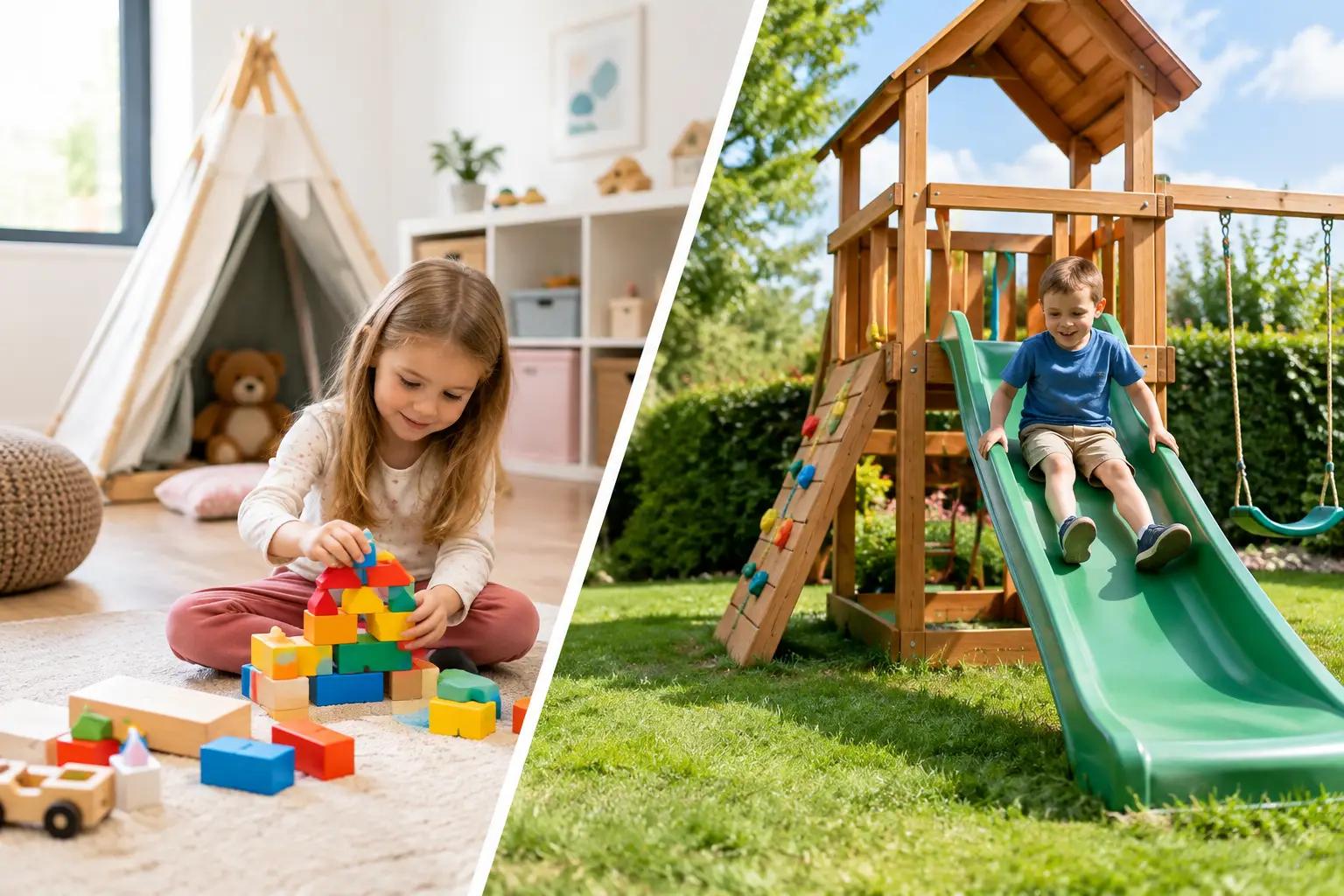
An indoor play area provides a controlled environment. It operates independently of rain, heat, wind, or seasonal conditions, making it a natural choice for shopping malls, restaurants, family hotels, children's centers, and venues with a constant flow of visitors. Play can be integrated into the interior through soft-play modules, climbing structures, themed elements, rope obstacles, and role-playing spaces.
An outdoor play area offers a different kind of valuable experience: outdoor movement, more space, natural light, and opportunities for larger-scale physical activities. Wooden playgrounds, rope structures, low ropes courses, climbing equipment, and zip lines encourage balance, strength, coordination, and confidence. For resorts, parks, schools, municipalities, and residential developments, these attractions can become a major asset that differentiates the location from competing destinations.
The difference is not about which option is universally "better." The real question is which solution serves your property and its visitors more effectively. In some projects, the most practical approach is a combination: a compact indoor area for year-round play and an outdoor playground for active activities during favorable weather conditions.
Indoor vs Outdoor Play Area Comparison
| Criteria | Indoor Play Area | Outdoor Play Area |
|---|---|---|
| Year-Round Use | Yes | Weather dependent |
| Environmental Control | Very high | Limited by climate conditions |
| Available Space | More compact | Supports larger installations |
| Physical Activity | Moderate | High |
| Maintenance | More predictable | Influenced by weather exposure |
When an Indoor Play Area Creates More Value
An indoor solution is particularly suitable when consistency is essential. A restaurant that relies on family visits throughout the year cannot make the children's experience dependent on the weather forecast. Likewise, a hotel serving conference guests and weekend visitors benefits from a space that allows parents to plan their day comfortably, regardless of outdoor conditions.
Control over the environment offers operational advantages as well. Lighting, temperature, access, and supervision can be managed more predictably. This simplifies maintenance and helps staff monitor the area, especially when the play zone is visible from the reception area, restaurant, or parent lounge.
However, indoor play areas require careful attention to capacity. Limited space should not be overcrowded with too many elements. A good concept creates clear movement routes, multiple challenge levels, and sufficient space between activities. Younger children need a lower, protected, and easily supervised environment, while older children benefit from climbing activities, balance challenges, and tasks that keep them engaged.
Acoustics should also be considered early in the planning process. Noise generated by active play can affect hotel guests, restaurant visitors, or the working rhythm of educational environments. Appropriate materials, zoning strategies, and the positioning of high-energy elements can make a significant difference in daily operations.
Advantages of Indoor Play Areas
- Year-round usability
- Full environmental control
- Easier supervision by staff and parents
- Predictable maintenance costs
- Ideal for commercial and indoor facilities
The Power of Outdoor Play
An outdoor play area creates an experience that is difficult to replicate indoors. The larger space allows for a wider variety of activities, including climbing, traversing, swinging, balancing, and collaborative challenges. This is not simply a way for children to expend energy. Well-designed physical play helps develop motor skills, spatial awareness, social interaction, and independence.
For hospitality and residential projects, an outdoor playground also delivers a strong visual presence. It is visible, recognizable, and often becomes a natural gathering point for families. A high-quality wooden or rope-based play structure can reinforce the architectural identity of the property rather than appearing as a standard element added at the last minute.
The trade-off lies in climate exposure and ongoing maintenance. Sunlight, moisture, temperature fluctuations, and intensive use place significant demands on materials, protective finishes, foundations, and installation quality. Seasonal inspections alone are not sufficient if the equipment is used daily. A clear plan for routine visual inspections, cleaning, technical checks, and timely maintenance is essential.
Shade is a critical factor rather than a decorative addition. It directly affects children's comfort, surface temperatures, and the actual amount of time the playground can be used during warmer months. Proper site orientation, natural vegetation, or purpose-designed shade solutions should be included from the earliest stages of planning.
Advantages of Outdoor Play Areas
- More space for active play
- Promotes balance, strength, and coordination
- Creates strong visual impact for the property
- Supports larger play and adventure structures
- Encourages longer outdoor stays for families
Which Type of Play Area Is Best for Different Facilities?
| Facility Type | Recommended Solution | Primary Reason |
|---|---|---|
| Restaurant | Indoor Play Area | Year-round usability |
| Shopping Mall | Indoor Play Area | Consistent visitor traffic |
| Hotel | Combined Solution | Maximum value in all seasons |
| School | Outdoor Play Area | Higher physical activity levels |
| Public Park | Outdoor Play Area | Large capacity and public accessibility |
| Residential Complex | Outdoor Play Area | Daily use by residents |
Safety Begins Before Choosing Equipment
Whether the space is indoors or outdoors, safety cannot be reduced to soft flooring and a set of rules. It is the result of a complete engineering and spatial solution that includes proper fall zones, appropriate heights, stable structures, reliable connections, controlled access, and clear age-group segmentation.
For outdoor playgrounds, surfacing and drainage are critical. Water accumulation, poorly prepared sub-bases, or surfacing that does not match the characteristics of the equipment can significantly compromise an otherwise excellent project. In indoor centers, the focus is often on fire safety, visibility, hygiene, evacuation routes, and protecting active play zones.
A professional design begins with risk assessment and user scenarios. Who will use the area? Will access be open or controlled? Will there be supervision staff? How will parents monitor and reach their children? The answers determine not only the type of equipment selected but also its layout and positioning.
Expert Recommendation
The most successful play environments begin with a thorough risk assessment and user behavior analysis long before equipment selection. This reduces future operational costs while improving long-term safety and performance.
The Budget Should Cover the Entire Lifecycle
The initial purchase price is important, but it is rarely the most accurate decision-making factor. A lower-cost solution may appear attractive initially, only to require more frequent repairs, replacement parts, and operational interruptions later. For commercial and public facilities, this represents not only additional costs but also a diminished visitor experience.
For indoor play areas, plan for room preparation, ventilation, lighting, flooring, access, and cleaning requirements. For outdoor playgrounds, include site preparation, drainage, surfacing, shade structures, landscaping, and future maintenance. In both cases, professional design, manufacturing, and installation form the foundation of long-term reliability.
Capacity also has financial value. A play area that is too small can lead to overcrowding and dissatisfied visitors, while an oversized installation may remain underutilized. Evaluate peak usage times, visitor demographics, and movement patterns throughout the facility to ensure that the investment aligns with actual demand rather than visual ambitions alone.
Planning the Real Budget
| Cost Factor | Indoor Play Area | Outdoor Play Area |
|---|---|---|
| Site Preparation | Indoor space and flooring | Groundworks and drainage |
| Safety Measures | Access control | Impact-absorbing surfacing |
| Maintenance | Cleaning and inspections | Inspections and weather exposure |
| Additional Costs | Lighting and ventilation | Shade solutions and landscaping |
How to Make the Right Decision for Your Facility
First, determine the role the play area should fulfill. If your primary objective is to increase dwell time for families in a restaurant or retail environment, a year-round indoor play area may deliver the most direct impact. If you are developing a hotel, park, school, or residential complex with available outdoor space, an active outdoor playground can become a defining feature of the environment.
Next, evaluate the site and building without assumptions. In some cases, a small but well-organized indoor play center delivers more value than a large outdoor area exposed to unfavorable conditions. In other situations, the available outdoor space can support an adventure route that would be impossible to create indoors.
Working with a partner that combines concept development, design, engineering, manufacturing, and installation reduces the risk of discrepancies between the original vision and long-term operation. At Edutain Attractions, this process is supported by structured project management, quality control procedures, and an ISO 9001:2015 certified organization because children's play deserves solutions that are both inspiring and responsibly executed.
The best play area does more than fill empty space. It gives children a reason to move, to try again, and to build friendships, while giving parents confidence that they have chosen a place where fun and safety go hand in hand.
Frequently Asked Questions
Which is better: an indoor or outdoor play area?
There is no universal answer. The best solution depends on the type of facility, available space, seasonality, and expected visitor traffic.
Is a combined solution a good option?
Yes. Many hotels and resorts combine indoor and outdoor play areas to maximize usability throughout the year.
Which option requires more maintenance?
Outdoor playgrounds are generally exposed to greater environmental impact and require more frequent inspections of surfacing, structures, protective coatings, and equipment components.
What is the most important factor when designing a play area?
Visitor analysis, safety, capacity planning, and long-term operational sustainability are often more important than the actual equipment selection itself.

Maria Mihova
Published on: November 3, 2026 | Last Updated: November 3, 2026Founder & CEO at Edutain Attractions
Maria designs and delivers immersive, educational play experiences for hotels, municipal parks, and resorts worldwide. With over 15 years in international business development and adventure products, she builds play environments that combine safety, learning, and fun. Find out more about me
