
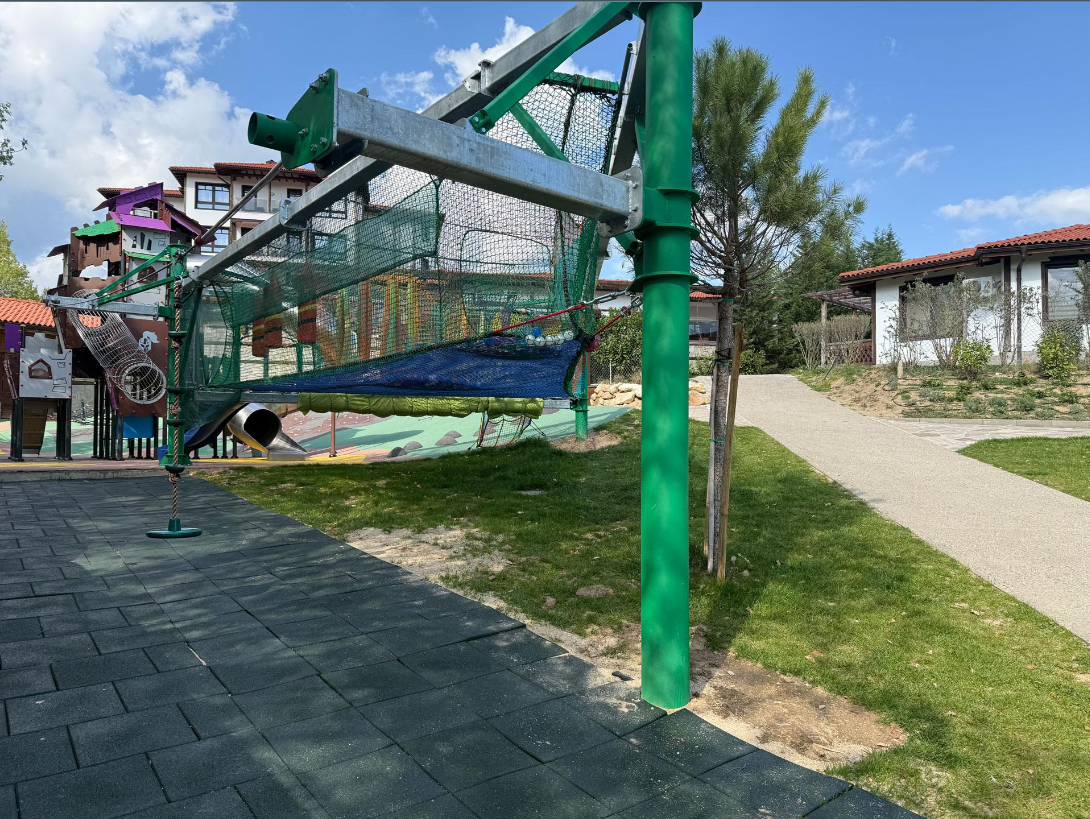
The Best Facilities for a Hotel Backyard
A quiet, unused patch of grass rarely makes a family choose the hotel again. A well‑designed active play zone, however, turns the courtyard into a reason for a longer stay, more peace for parents, and genuine joy for children. The best outdoor hotel play facilities are not just colourful elements placed next to the pool. They are part of the guest experience and must operate reliably under intensive daily use.
For hotels and resorts, the choice also has a business dimension. Families value places where children can move freely and safely while adults relax nearby. When the space is selected according to the guest profile, terrain, and operational capabilities of the venue, it adds value to the stay without creating unnecessary burden for the staff.
The best hotel courtyard play facilities start with a purpose
Before choosing a slide, swing, or rope element, one essential question must be answered: what role should the courtyard play for this specific hotel? In an urban hotel with limited space, the zone may serve as a compact area for short play between breakfast and a walk. In a seaside or mountain resort, it may support hours of daily activity and become an attraction in its own right.
The age profile is decisive. Young children need low platforms, clear routes, protected steps, and activities that develop balance and coordination. For school‑age children, climbing structures, rope nets, bridges, low rope courses, and challenges that encourage independent exploration are more appealing. A zone aimed at all ages often serves none of them well. A better approach is to create distinct yet visually connected areas.
Seasonality also shapes the decision. If the hotel operates year‑round, the equipment must retain its function and appearance under sun, moisture, temperature changes, and frequent use. For seasonal venues, the focus may shift toward fast visitor flow, easy cleaning, and materials suited to coastal or mountain conditions.
Facilities that create real value
The most successful hotel courtyard rarely relies on a single large element. It offers different ways to move, meet, and engage in imaginative play. This keeps children interested for longer and makes the area feel lively without being overcrowded.
Combined play structures
A combined play structure is a practical core solution for venues that want to support several types of play within a relatively compact area. It can integrate towers, slides, bridges, activity panels, and climbing elements. The advantage is clear organisation and high play value per square metre.
Here, the compromise should never be in material quality. A hotel environment carries heavier load than a private backyard, and small defects quickly influence the impression of the entire venue. The structure must be engineered for outdoor conditions, with reliable connections, durable coatings, and details that allow easy maintenance.
Rope structures and low rope courses
Rope nets, balance bridges, and low rope courses are a strong choice for resorts that want a more natural and adventurous atmosphere. They develop strength, coordination, confidence, and judgement without turning play into a competition that excludes less confident children.
These solutions are especially suitable for green courtyards, around trees, or near relaxation areas. But they require precise engineering planning. Height, rope tension, fall zones, and maintenance access should never be decided on site. They are part of the project from the very first drawing.
Zip lines and more dynamic attractions
A short zip line can give a hotel courtyard a distinctive character and create a moment children remember. It is suitable for larger areas and for audiences seeking an active holiday. It works best as part of an adventure route with climbing, balance elements, and natural observation points.
This is not a universal solution. A zip line requires sufficient length, a proper clear perimeter, appropriate surfacing, and a clear usage regime. For a small urban hotel, a more compact rope structure may offer greater value and easier operation.
Timber play structures with character
Timber brings warmth and a natural presence that complements gardens, eco‑hotels, mountain resorts, and boutique accommodation. It can turn the play area into part of the landscape rather than a separate plastic object placed on top of it.
A premium timber playground, however, does not mean simply using untreated beams. Quality is evident in the selection and treatment of the material, protection against weather conditions, structural stability, and control over every point of contact between child and equipment. A well‑executed timber system combines natural aesthetics with predictable durability.
Safety is not a separate feature
For a hotel operator, a safe play area is both a responsibility toward guests and protection of the venue’s reputation. It is not achieved through a sign with rules. Safety is built through proper zoning, appropriate clearances, controlled heights, stable foundations, correctly selected impact‑absorbing surfacing, and professional installation.
Surfacing deserves special attention. It must correspond to free‑fall height, expected use, climate, and cleaning needs. Some venues prefer a natural look, others seek easier maintenance and clearly defined colour zones. There is no universally correct choice, but there is an incorrect one: surfacing selected solely by price or appearance.
Designing for guests, staff, and terrain
A well‑designed play area is not placed in the most available corner of the property. It is positioned so that parents have visibility from the terrace, restaurant, pool, or relaxation zone, without children’s activity disturbing the comfort of other guests. Shade, access to water, lighting, and the movement of service staff must be considered from the very beginning.
Visual language matters. In a premium hotel, the play area should support the architecture and character of the venue, not look like a standard catalogue product. Custom forms, thematic details, and materials can tell the story of the location — a seaside adventure, a forest expedition, or a fairy‑tale route. What matters is that the theme serves the play experience, not hides the absence of function.
A complete process — from concept and engineering work to production, delivery, and installation — reduces the risk of mismatches between idea, budget, and real terrain. This is why operators look for a partner who takes responsibility for the system as a whole. The Edutain Attractions approach combines this level of control with design that encourages movement, imagination, and development.
How to make a decision with long‑term value
When comparing proposals, do not look only at the number of elements or the initial price. It is far more useful to evaluate what the hotel will have after five years of use: preserved appearance, reliable structure, available spare parts, clear documentation, and a play area that continues to attract families.
Request that the project shows real dimensions, safety zones, surfacing, installation access, and the relationship with the surrounding landscape. Clarify who is responsible for site preparation, anchoring, final acceptance, and staff instruction. An organisation certified under ISO 9001:2015 is an additional signal that quality is managed consistently rather than left to chance.
A hotel courtyard may have limited space, but it can carry great importance for the family experience. When you give children a place where they can climb, balance, invent games, and make friends, you give parents something equally valuable — confidence that they have chosen a place where everyone feels good.
FAQ
1. What makes a hotel play area truly valuable?
When it is designed around guest profile, terrain, and daily load, not as decoration near the pool.
2. Why start with the purpose of the space?
Because a courtyard can be a compact city zone, a full resort attraction, or a quiet play area – each needs different design.
3. How to choose based on age groups?
Toddlers → low platforms, protected steps, clear routes.
Older kids → climbing, ropes, bridges, challenges.
4. Which equipment creates the most value?
Combined playgrounds, rope structures, low rope courses, zipline, premium wooden playgrounds.
5. Is a zipline suitable for every hotel?
No. It requires length, clearance, surfacing, and controlled use.

Maria Mihova
Published on: September 07, 2026 | Last Updated: September 07, 2026Founder & CEO at Edutain Attractions
Maria designs and delivers immersive, educational play experiences for hotels, municipal parks, and resorts worldwide. With over 15 years in international business development and adventure products, she builds play environments that combine safety, learning, and fun. Find out more about me
