
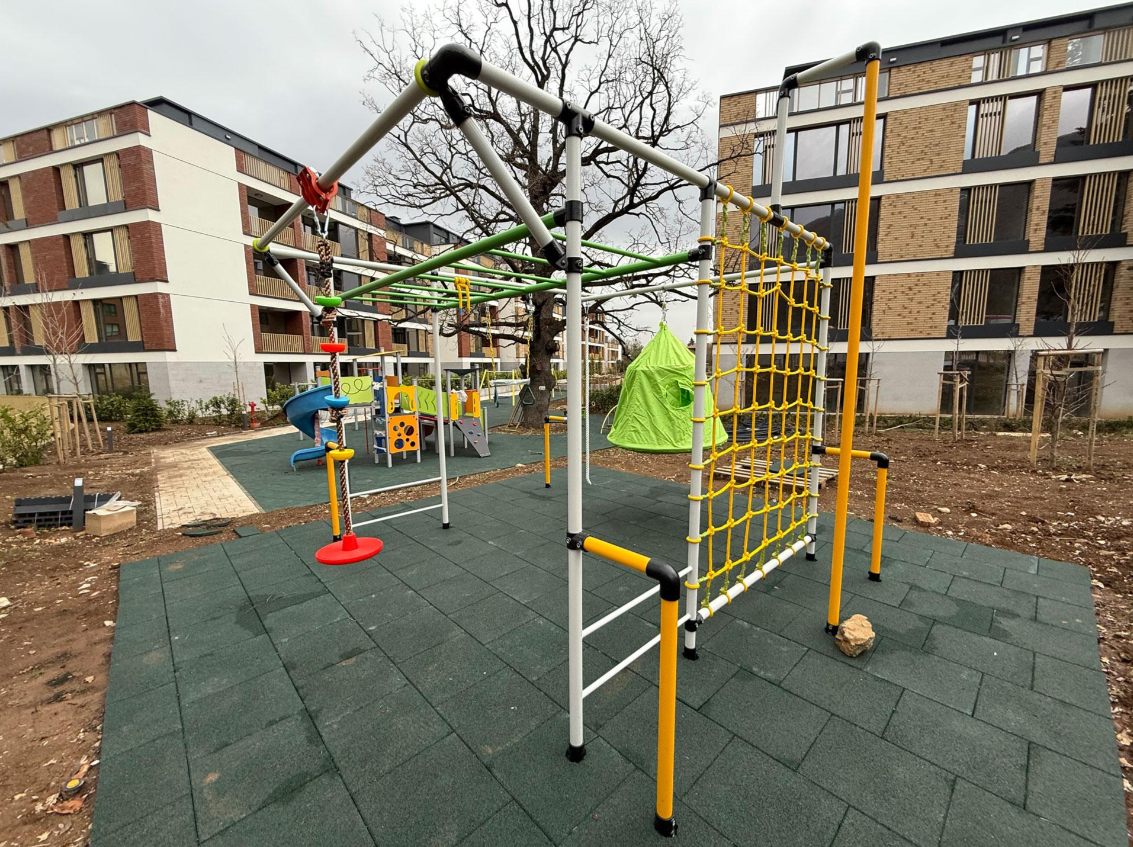
Low-Rope Adventure Course Equipment
When a play area needs to be attractive, safe, and genuinely used, low‑rope playground structures often prove to be a stronger solution than the standard slide‑swing‑climber set. They create purposeful movement, encourage balance, coordination, and confidence, and give investors or operators a clear answer to one important question — how to make the space work actively for children’s experience and for the value of the venue.
This type of equipment is especially suitable for environments where safety and visual quality cannot be compromised. Hotels and resorts use them to offer an active family zone. Schools and kindergartens choose them for motor development. Municipalities and residential complexes prefer them when they need long‑lasting infrastructure with high public benefit.
What low‑rope playground structures are
Low‑rope playground structures are systems of balance, traversal, and climbing elements positioned at a small height above the ground. They typically include rope bridges, stepping elements, beams, nets, balance features, and combined routes where the child moves through a sequence of challenges without feeling excessive risk.
Their essence is not simply moving from point A to point B. A well‑designed low‑rope zone teaches the child to evaluate, to plan the next step, to adjust their body in motion, and to test their own limits in a controlled environment. This is one of the reasons these solutions are seen not just as entertainment, but as part of a more meaningful play and edutainment concept.
Why this format works so well
In traditional playgrounds, children often use the equipment briefly and repeat the same actions. Low‑rope elements introduce sequence, choice, and micro‑challenges. This extends playtime and keeps interest naturally high.
From a developmental perspective, the benefits are concrete. Balance and coordination improve through repeated traversal along different trajectories. Grip strength, core stability, and spatial awareness develop without feeling like exercise. For less confident children, the low height is important — it reduces fear and makes participation more accessible.
For adults managing the venue, there is another major advantage. These structures have strong visual character. They give the space identity and can be integrated into a broader architectural and landscape concept, rather than appearing as standard, interchangeable equipment.
Where low‑rope structures deliver the greatest value
In hotels and resorts, low‑rope courses work exceptionally well when the goal is to keep families on the property longer. The children’s zone is not just a convenience — it becomes part of the overall guest experience. When well designed, it elevates the perceived quality of the venue and strengthens the brand’s family‑friendly reputation.
In schools and kindergartens, the value is even more direct. Physical activity becomes more diverse, and the space can be used both for free play and structured activities. Here, a good project must consider age groups, usage flow, and the ability for teachers to supervise effectively.
In municipal spaces and residential complexes, long‑term durability is the key factor. The zone must withstand heavy use, varying climate conditions, and daily activity from many children. This is why material selection, engineering solutions, and professional installation carry such weight.
What distinguishes a good project from simply arranged elements
Not every composition of ropes and platforms creates a quality experience. A good low‑rope environment begins with a clear understanding of the user, the location, and the expected outcome. There is a difference between a zone meant to activate a small kindergarten yard and one intended to become an attraction for a resort or a city park.
Flow of play
A successful course has rhythm. It alternates easier and more challenging sections, creates a sense of progression, and accommodates different confidence levels. If everything is too easy, interest drops. If everything is too difficult, some children disengage right at the start.
Clear age logic
One of the most common mistakes is trying to create a universal solution for everyone. In practice, the needs of a preschool child differ significantly from those of older students. Heights, distances, grip diameters, angles, and transition complexity must be precisely aligned with the target age group.
Visibility and control
For operators and staff, easy visibility of the space is essential. This is especially relevant for hotels, educational institutions, and public venues with higher traffic. Good visibility increases real safety and simplifies daily operation.
Safety without compromise — but also without sterile play
In the design of low‑rope playground structures, safety is not a separate stage but the foundation of the entire system. This includes correct height selection, adequate clearance zones, impact‑absorbing surfacing, stability of load‑bearing elements, appropriate rope components, and professional installation.
There is, however, a finer point. If the project becomes overly cautious to the extent that it eliminates every challenge, it loses much of its value. A child needs controlled effort — a small amount of uncertainty they can overcome. This is where confidence and independent judgement are built. The task of a good contractor is to balance safety with meaningful experience.
Materials, craftsmanship and operational lifespan
For B2B and B2G clients, long‑term value is just as important as the initial visual impact. A low‑quality solution may appear acceptable at handover, yet begin causing issues after the first active season. Rope wear, unstable connections, compromised wooden elements, or difficult maintenance can quickly turn an “economical” choice into a more expensive one.
This is why the project must be evaluated through its full lifecycle. How the material ages. How it behaves under UV exposure, moisture, temperature fluctuations, and intensive use. How easily it can be inspected and serviced. Premium execution is not only a matter of aesthetics — it is a matter of predictability and reliability in operation.
How a strong commissioning process unfolds
The strongest results come when the client does not begin with a catalogue, but with a clear objective. Do you want to activate an unused area, increase the family appeal of the venue, create educational value, or build a signature zone with high visual impact? The answer defines the entire concept.
Next comes a location analysis — dimensions, access points, surfacing, climate specifics, age groups, and expected capacity. From there, the project must move through concept, design, engineering development, production, delivery, and professional installation. This sequence reduces the risk of compromises between the initial idea and real‑world feasibility.
Companies like Edutain Attractions work precisely in this model — from concept to installation, with a focus on safety, durability, and environments that bring joy and real developmental value to children. For the client, this means better quality control and clearer accountability at every stage.
When low‑rope structures are not the best solution
There are cases where this format is not the leading choice. If you have very limited space and need maximum capacity for multiple age groups within a minimal footprint, a compact multifunctional structure may work better. If the audience consists mainly of very young children, the course must be heavily adapted — otherwise its potential will not be fully utilised.
Additionally, if the venue is not prepared for regular inspections and maintenance, the operational side should not be underestimated. Although low‑rope systems are long‑lasting when executed correctly, they still require disciplined operation, just like any high‑quality play infrastructure.
How to recognise the right solution for your project
The useful question is not simply whether you like this type of equipment. The question is whether it supports the purpose of the space. If you want more movement, longer engagement, stronger visual identity, and an experience that combines play with development, low‑rope solutions offer a significant advantage.
Look for a project that does not rely solely on striking visuals. You need engineering clarity, logical user flow, high‑quality materials, and professional installation. When all these elements work together, the result is not just a playground. You get an environment where children move confidently, parents feel at ease, and the venue itself gains stronger presence and long‑term value.
The best play spaces do not shout — they stay in the memory of families. If you are planning a new playground or upgrading an existing area, a low‑rope solution deserves a careful look, especially when you seek quality that is felt from the very first step.
FAQ
1. What are low‑rope playground structures?
They are low‑height balance, climbing and traversal elements designed to create purposeful movement, micro‑challenges and natural skill development.
2. Why do low‑rope systems outperform traditional playgrounds?
They offer sequence, choice and rhythm, keeping children engaged longer and encouraging repeated, meaningful movement.
3. Where do low‑rope structures deliver the strongest results?
In hotels, resorts, schools, kindergartens, municipal parks and residential complexes, where safety, durability and visual identity matter.
4. What distinguishes a good design from a simple arrangement of elements?
Clear flow, age‑appropriate difficulty, visibility, balanced challenge and safety integrated without removing the sense of adventure.
5. How do I choose the right contractor?
Look for end‑to‑end capability, engineering clarity, production discipline and certified processes such as ISO 9001:2015.
Maria Mihova
Published on: August 10, 2026 | Last Updated: August 10, 2026Founder & CEO at Edutain Attractions
Maria designs and delivers immersive, educational play experiences for hotels, municipal parks, and resorts worldwide. With over 15 years in international business development and adventure products, she builds play environments that combine safety, learning, and fun. Find out more about me
