
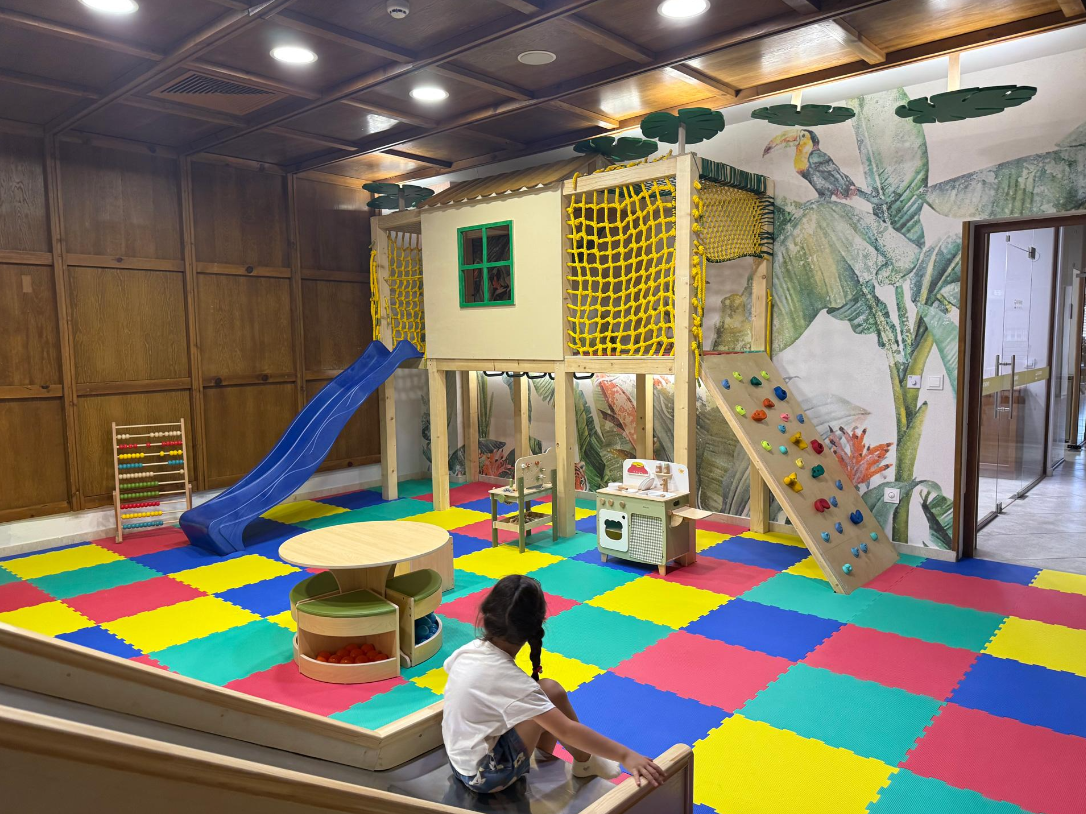
How to Set Up Children's Playgrounds at Hotels
Families choosing a hotel evaluate more than the room, the pool, and breakfast. Parents remember whether their children were genuinely engaged — not simply placed in front of a screen. This is why the question of how to equip a hotel play area is a strategic hospitality decision, not an interior add‑on. A well‑designed play zone extends the time families spend in shared spaces, brings calm to adults, and gives the hotel a clear reason to be preferred by family guests.
How to equip hotel play areas
Before choosing the first piece of equipment, the role of the play area within the overall guest experience must be defined. In an urban business hotel, a compact indoor zone can give children a short, high‑quality break while parents complete check‑in or talk in the lobby. In a seaside, mountain, or holiday resort, the play area can become a standalone attraction that encourages guests to stay on the property throughout the day.
There is no universal size or fixed set of elements. The right solution depends on visitor profile, number of rooms, seasonality, available space, and nearby services. A hotel welcoming many families with children aged 3 to 10 has different needs from a boutique venue visited mainly on weekends by parents with toddlers. Analysing these factors prevents a common mistake — a beautiful zone that does not match the real flow of guests.
The business effect matters as well. The play area should contribute to higher satisfaction, positive reviews, and repeat bookings without turning the hotel team into full‑time supervisors. This means clear visibility, predictable maintenance, and a structure designed for intensive daily use.
Start with the site, not the catalogue
The location determines almost every subsequent decision. An outdoor play area is a strong asset when it has natural shade, good visibility from the restaurant or terrace, and a safe distance from vehicle access, pools, and service routes. If the zone is close to the places where parents spend time, it is used more often and supervised more naturally.
Indoor play areas offer a different advantage — they add value year‑round and remain reliable in bad weather. However, room height, evacuation routes, sound insulation, ventilation, and durable flooring must be planned in advance. A soft‑floor system is not just a matter of appearance. It must suit the type of play, reduce fall risk, and allow fast, hygienic cleaning.
Separate the play area by age and type of play
A 2‑year‑old and a 10‑year‑old do not use a play area in the same way. Younger children need low platforms, soft volumes, sensory panels, and play close to the ground. Older children look for challenge — rope elements, nets, climbing walls, balance routes, or low rope courses.
Separation does not always require a physical barrier. It can be achieved through different difficulty levels, material zones, and logical layout. The quieter corner for younger children should be distinct from the dynamic climbing routes. This way, the hotel offers choice rather than a uniform experience for everyone.
Thematic concept also matters when it is connected to the location. A mountain hotel can use motifs from a forest expedition, a seaside resort can draw on ship routes and coastal forms, while an urban hotel can rely on abstract architectural play. The theme should not be a decorative mask placed over standard elements. It must guide movement, imagination, and the way the child experiences the space.
When space is limited, it is not wise to accumulate many small elements. A compact, multifunctional structure with climbing, balancing, traversing, and calm play features often delivers more value than a crowded room. The space should maintain clear routes, visible entrances, and enough room for children to move without constant collisions.
Safety is part of the design, not a final inspection
In a hotel environment, safety begins with planning access, fall zones, and visibility. Every platform, net, ladder, or climbing element must have the correct distance from neighbouring components and surfacing with appropriate characteristics. For outdoor play areas, this includes compliance with applicable equipment and impact‑absorbing surface requirements such as EN 1176 and EN 1177 when the project follows these standards.
Materials must withstand real hotel‑level use: sun, moisture, frequent cleaning, sand, salty coastal air, and high usage frequency. Quality timber, treated metal components, durable ropes, and reliable connectors are an investment in fewer interruptions and a longer lifespan for the play area.
Safety also includes the operational model. The hotel must have clear usage rules, marked age groups, periodic visual inspections, and a procedure for responding to damage. This does not mean an environment full of prohibitions. A good play area allows reasonable risk — letting the child climb, balance, and make decisions without the structure exposing them to unacceptable danger.
Choose play that develops and keeps attention
The most successful hotel play areas do not rely on a single slide. They offer opportunities for different types of activity: physical movement, social play, imaginative scenarios, and short rest. A child who can choose between a rope route, an interactive panel, and a small role‑play corner stays engaged for longer.
Climbing and balancing develop coordination, strength, and confidence. Rope structures offer challenge without necessarily requiring a large footprint. Interactive panels can introduce an educational element through shapes, sounds, tactile surfaces, and cooperative tasks. For family‑oriented hotels, this is a more meaningful alternative to passive entertainment.
Avoid solutions that are impressive only on opening day. A modular, multi‑layered experience has better long‑term value because children discover new ways to play with every visit. In larger complexes, an additional attraction such as a zip line, low rope course, or themed tower can be added — but only if the zone’s capacity, supervision, and maintenance allow it.
Plan the project as a long‑term asset
The cost of the equipment is only part of the investment. From the very beginning, site preparation, foundations, surfacing, lighting, drainage, delivery, installation, and future maintenance must be considered. A low initial price can become expensive if it requires frequent repairs, loses its visual quality, or cannot withstand a busy season.
The most reliable approach is for the project to follow a unified professional sequence: site and guest analysis, concept, technical design, production, delivery, installation, and final acceptance. This reduces the risk of the design not matching real on‑site conditions. In premium solutions, quality control and a disciplined process — including working under ISO 9001:2015 principles — give the operator greater predictability.
Edutain Attractions develops such complete environments with a focus on active play, durable materials, and distinctive design. But regardless of the chosen partner, the hotel operator should look for proven experience with public and commercial venues, clear technical documentation, and professional installation — not just attractive visualisations.
Don’t forget accessibility and parent comfort
Inclusive design expands the value of a play area. Accessible routes, ground‑level play elements, sensory activities, and seating close to the zone allow more families to use it confidently. Not every piece of equipment must be suitable for every child, but the overall environment should not exclude visitors without reason.
Parent comfort is just as practical a criterion. Shade, benches, good lighting, proximity to restrooms, and clear visibility of the zone turn short waiting time into pleasant time. When the adult feels at ease, the child gains more freedom to play.
A hotel play area is at its strongest when it does not look like a mandatory children’s corner, but like a natural part of the venue’s character. Create a place children want to return to before they have even left the hotel — and where parents are already planning their next stay.
FAQ
1. Why is a hotel play area a strategic decision?
Because it drives guest satisfaction, reviews, repeat bookings, and time spent on property.
2. How to define the purpose of the play area?
Based on guest profile, seasonality, room count, available space, and nearby services.
3. What matters most when choosing the location?
Visibility for parents, natural shade, safe distance from pools and roads, convenient access.
4. How to equip an indoor play area?
Consider height, evacuation, acoustics, ventilation, durable soft flooring, and clear movement routes.
5. Why is age zoning essential?
Because toddlers and older kids have different needs, difficulty levels, and play styles.

Maria Mihova
Published on: September 08, 2026 | Last Updated: September 08, 2026Founder & CEO at Edutain Attractions
Maria designs and delivers immersive, educational play experiences for hotels, municipal parks, and resorts worldwide. With over 15 years in international business development and adventure products, she builds play environments that combine safety, learning, and fun. Find out more about me
