
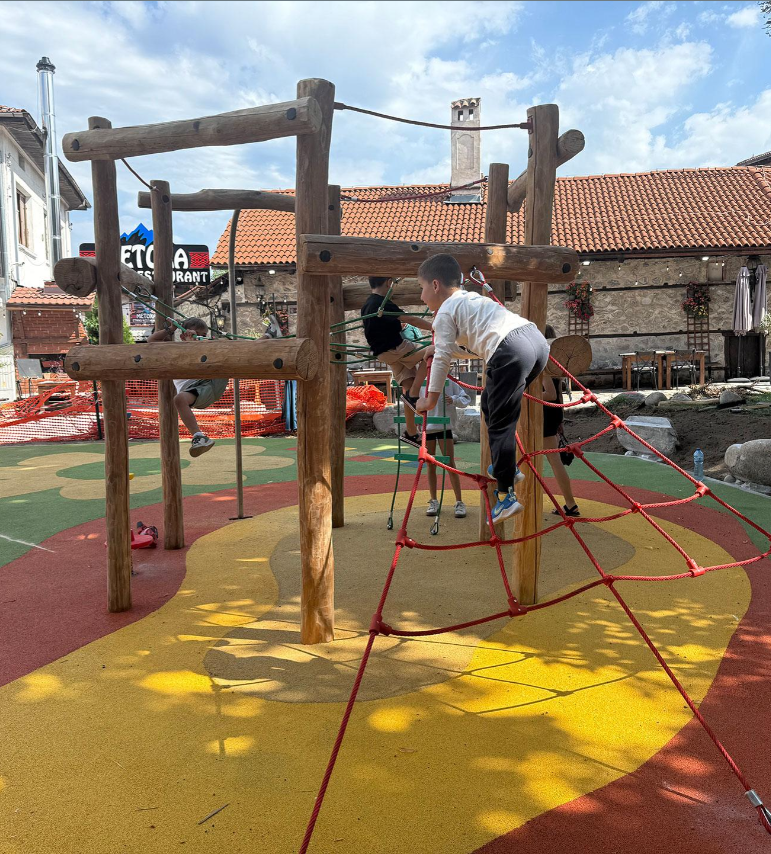
Children's playgrounds for schools
Recess is not a break from learning. It is the moment when children release energy, practice coordination, negotiate rules, and build confidence through movement. That’s why school playgrounds should not be viewed as a simple extension of the yard, but as part of the educational environment — with a direct impact on activity levels, concentration, and the overall perception of the school.
When a school plans a new playground, it usually faces several equally important questions. How can safety be ensured without limiting play? How can a solution be chosen that withstands intensive daily use? And how can the space remain engaging for different age groups instead of becoming empty once the initial excitement fades? The right answer is not the biggest structure, but the right combination of design, engineering, materials, and a real understanding of children’s behaviour.
What makes good school playgrounds
A school playground operates under different conditions than one in a residential complex or a hotel. The load is higher, the number of users is larger, and playtime is often short and intense. This means the equipment must withstand a constant flow of children without losing stability, functionality, or visual order.
High‑quality school playgrounds create clear movement scenarios. They include elements for climbing, balancing, hanging, traversing, and short challenges that keep children engaged without causing chaotic clustering in one spot. A good playground is not just a collection of a slide, a swing, and a tower. It is an environment where children naturally distribute themselves according to age, confidence, and preferred type of play.
Equally important is that the playground continues to offer value after the first year. If all elements are too easy, older students quickly lose interest. If they are too difficult, younger children cannot use them effectively. This is where the difference becomes clear between standard equipment and a project designed specifically for the school.
Safety that doesn’t kill play
In school projects, safety is the first filter — but not the only criterion. The best solutions do not reduce risk to a sterile environment; they manage risk intelligently. Children need movement, height, obstacle‑solving, and a sense of achievement. The task of the project is to make this possible within a controlled, predictable, and reliably executed framework.
Here, factors such as fall heights, safety zones, the correct impact‑absorbing surfacing, structural durability, and clear logic of access and descent all play a crucial role. Just as important are the details — no dangerous entrapment points, precisely finished surfaces, durable connections, and materials that age well outdoors.
For school administrations and project owners, this means thinking not only about the purchase but about the entire life cycle of the playground. A cheap solution often looks budget‑friendly at first, but can become expensive through faster wear, more frequent maintenance, and a shorter period of safe operation.
Designing for age, capacity, and the school environment
One of the most common mistakes is trying to create a universal playground for everyone. In reality, the needs of preschool children, early‑grade students, and middle‑grade students are very different. This doesn’t mean the yard must be strictly divided, but it does mean that zones and challenges should be selected with the real users in mind.
Younger children need lower heights, clear routes, and more sensory and role‑play elements. Early‑grade students look for more dynamic activities related to climbing, balance, and social play. Older children respond well to rope structures, combined courses, strength‑and‑balance equipment, and more complex routes that give a sense of progression.
It also matters how the playground fits into the overall organization of the yard. If the space is narrow, vertical solutions and rope elements often work better than a wide, spread‑out composition. If the school has a larger area, separate active zones can be created to distribute load and reduce conflict between different age groups.
When a standard solution isn’t enough
Standard systems are suitable in some cases, especially when the goal is quick implementation and basic functionality. But for schools with a larger number of students, a specific yard layout, or a desire for a clearly recognizable environment, a customized approach usually delivers a better result.
A tailored project allows the terrain to be used more efficiently, combines movement with educational elements, and achieves a visual identity that contributes to the school’s character. This is especially valuable when the leadership wants the yard to look maintained, contemporary, and purposefully developed — not assembled from random components.
Materials and durability under intensive use
In a school environment, durability is not an abstract quality. It is visible every day — in whether colours and surfaces remain intact, whether the structure stays stable, whether details loosen over time, and whether maintenance is predictable. Materials must be selected according to climate, load, and the desired visual effect.
Wooden playgrounds bring warmth and a natural character, but they require proper material selection and professional treatment to perform long‑term. Steel and rope structures offer excellent durability and allow more dynamic forms. A combination of different materials is often the best solution when balancing visual identity, strength, and budget.
Surfacing is not a secondary choice either. It affects safety, maintenance, drainage, and the overall sense of quality. In areas with intensive flow and a strict school schedule, the surfacing must be reliable, easy to clean, and suitable for the season and climate conditions.
From idea to installation — why the process matters
In public and educational projects, the final result depends not only on the product but also on the discipline of execution. A well‑organized process begins with an analysis of the site, age groups, capacity, and usage patterns. Then come the concept, design, engineering development, production, delivery, and on‑site installation.
This sequence reduces the risk of compromises along the way. When the project is approached holistically, typical issues are avoided — unsuitable clearances, inconvenient access routes, insufficient visibility for supervision, and elements that look good on paper but fail in everyday use.
For the client, this also brings another advantage: clearer control over timelines, budget, and responsibilities. In complex environments, a partner with experience in design, manufacturing, and installation can save significant time and reduce hidden costs. Companies like Edutain Attractions work precisely with this logic — the playground is treated as a complete environment, not as a collection of isolated components.
The role of quality installation
Even a well‑designed playground can be compromised by poor installation. Leveling, anchoring, surfacing execution, and checking every connection are critical. In a school environment, where heavy use begins immediately and continues daily, there is no room for improvisation.
Professional installation is part of safety. It is also part of the long‑term value of the investment, because a properly installed system is easier to maintain and preserves its characteristics for longer. High‑quality installation ensures structural stability, predictable performance, and a safer experience for children — all essential components of a reliable playground lifecycle.
How to evaluate a school playground proposal
The lowest price is rarely the best indicator. It is far more useful to compare several layers of value: the project approach, proven safety, material quality, clear production standards, installation, warranty conditions, and the expected lifespan of the system.
Pay attention to whether the proposal is tailored to the specific site and users, or simply a template. Check whether there is real thinking about capacity and child movement. Look for clarity on what exactly is included — from foundations and surfacing to final installation and documentation.
If the playground is meant to serve for many years, value lies in its ability to operate reliably, look good, and continue attracting children, not just in being delivered on time. This is where premium execution pays off — through fewer issues, better usability, and a stronger impact on the school environment.
More than a schoolyard — a space that stays in memory
The most successful school playgrounds are not just safe. They are lively, recognizable, and loved. Children seek them out, teachers see them as a useful part of the daily rhythm, and parents notice care, quality, and a commitment to development.
When a playground is planned with movement, joy, and durability in mind, it begins to work far beyond free time. It supports social skills, encourages activity, and shows that the school invests in an environment that respects childhood. Approaching the project from this perspective makes the choice clearer and the result significantly more valuable.
FAQ
1. What makes a school playground truly effective?
It must withstand high daily use, offer structured movement scenarios, and stay engaging across age groups. “The load is higher… equipment must withstand a constant flow of children.”
2. How do you ensure safety without limiting play?
Through controlled heights, impact‑absorbing surfacing, clear safety zones, durable materials, and precise detailing that support active movement.
3. How should playgrounds be designed by age and capacity?
Younger kids → low heights, sensory and role‑play elements. Primary students → dynamic movement, balance, climbing. Older students → rope structures, combined routes, strength/balance challenges.
4. When is a standard solution not enough?
When the school has high student volume, a complex yard, or wants a distinctive, modern environment, custom design performs better.
5. How should schools evaluate a playground proposal?
Compare design logic, safety, materials, standards, installation, warranty, lifecycle, and alignment with the actual yard and users.

Maria Mihova
Published on: July 31, 2026 | Last Updated: July 31, 2026Founder & CEO at Edutain Attractions
Maria designs and delivers immersive, educational play experiences for hotels, municipal parks, and resorts worldwide. With over 15 years in international business development and adventure products, she builds play environments that combine safety, learning, and fun. Find out more about me
