
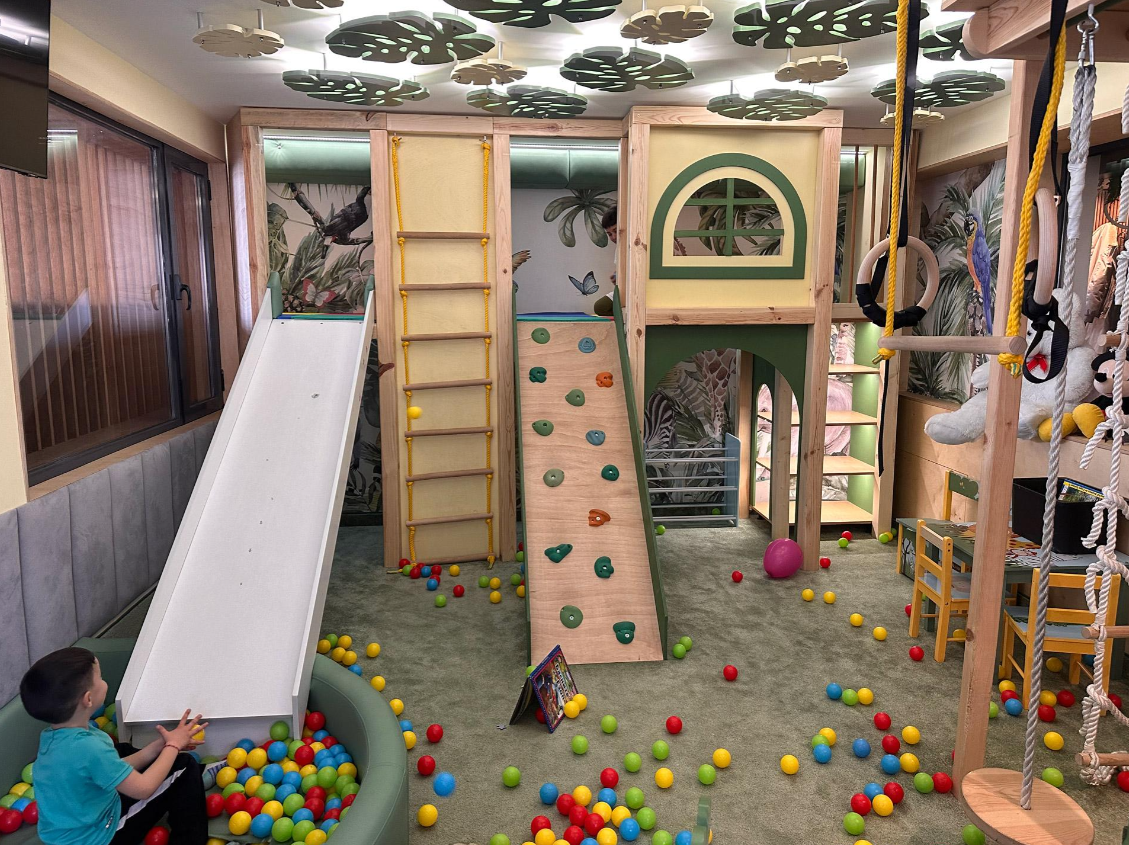
Children's playgrounds for restaurants
When a family chooses where to have lunch or dinner, the menu is not always the deciding factor. Very often the choice depends on whether the place feels calm for parents and engaging for children. That’s why restaurant playgrounds are no longer just an extra feature — they are a real tool for better customer experience, longer stays, and stronger loyalty.
For restaurant owners and operators, the solution has to work in several directions at once. It must attract families, be safe, withstand intensive use, and fit the concept of the venue. A well‑designed play area is not a random structure placed in a corner. It is part of the overall spatial strategy and the commercial logic of the restaurant.
Why restaurant playgrounds have a direct business impact
Restaurants that welcome families often face the same challenge — children get bored quickly, which shortens the stay and puts pressure on the staff. When there is a high‑quality play space, the atmosphere changes. Parents feel calmer, order more confidently, and perceive the venue as convenient for repeat visits.
There is also a more subtle effect. The play area doesn’t serve only for entertainment — it builds reputation. Families remember places that consider their real needs. This is especially valuable in highly competitive urban locations, resort complexes, family hotels, and venues with large outdoor areas.
Of course, not every playground delivers the same result. A small, poorly positioned, or visually worn‑out zone may remain almost unused. Strong return on investment comes when the project is aligned with visitor flow, age groups, and the operational model of the restaurant. This is where thoughtful spatial planning and a tailored concept make a measurable difference.
What makes a playground suitable for a restaurant
The key is the balance between play, control, and integration with the venue. A restaurant environment is different from a park, a school, or a residential complex. Here you have service dynamics, staff routes, hot drinks, constant movement, and the need for visibility.
A suitable playground allows children to be active without intersecting with the main service zones. It must be close enough for parents to supervise, yet sufficiently separated to create a sense of an independent children’s space. This often requires an individual approach rather than a standard catalogue solution.
Materials matter as well. In a restaurant setting, equipment is used intensively and often daily. Surfaces must be weather‑resistant, easy to maintain, and pleasant to the touch. For outdoor areas, resistance to UV, moisture, and temperature changes is essential. For indoor zones, hygiene, acoustic comfort, and easy cleaning are key factors. Thoughtful material selection and spatial planning ensure the playground supports both the guest experience and the operational model of the restaurant.
Safety is not a detail — it is the foundation
When planning restaurant playgrounds, safety doesn’t begin at installation. It begins at the concept stage. From the very first steps, there must be clear thinking about age groups, fall heights, protective zones, surfacing, and access control.
A restaurant environment adds specific risks. There must be no direct access for cars, service entrances, unprotected stairs, or staff routes with trays passing near the play area. For outdoor spaces, shade must be considered to prevent equipment from overheating during warm months. For indoor solutions, visibility and capacity must be managed to avoid overcrowding during peak hours.
Good practice requires equipment produced to clear standards, installed professionally, and maintained on schedule. This is where the project approach matters. When design, engineering, manufacturing, and installation are managed as one process, the risk of compromise is significantly lower — and the final result is safer, more reliable, and more valuable for the venue.
Outdoor or indoor playground — it depends on the venue model
There is no universally correct choice. For restaurants with a garden, yard, or resort‑style terrain, an outdoor playground is often the strongest asset. It creates visual presence, uses natural space, and allows more dynamic play — climbing, balancing, rope elements, or themed structures.
For urban restaurants with limited space, an indoor zone may be more practical. It extends usability throughout the year and reduces dependence on weather. But it requires more precise planning of noise, ventilation, cleaning, and supervision.
Hybrid solutions also exist. Some venues work exceptionally well with a compact indoor zone for younger children and an outdoor area for more active play. This model is especially suitable for restaurants in family complexes, shopping centres, and holiday destinations. Thoughtful spatial planning and concept development ensure the playground fits the operational logic of the venue and enhances the guest experience.
Design should carry character, not just function
A playground is part of the restaurant’s brand. If the interior and the cuisine communicate quality, but the children’s area feels random, guests sense a disconnect. That’s why visual integration is more than aesthetics — it reinforces the overall perception of the venue.
For premium positioning, solutions with natural materials, a clear theme, and a controlled, well‑balanced colour palette work best. For family‑oriented restaurants with a more vibrant identity, playful forms, educational elements, and role‑play scenarios can be used. What matters is that the design isn’t loud for the sake of loudness. It should attract without overwhelming the space.
There is also a frequently underestimated opportunity — the play environment can develop motor skills, coordination, and imagination instead of simply distracting. This is where edutainment‑focused concepts deliver higher value for both children and the venue. Thoughtful design and purposeful play scenarios turn the playground into an experience that strengthens the restaurant’s identity and enhances the guest journey.
How to plan the investment wisely
The cost of the project should not be viewed only as the price of the equipment. It is more accurate to think of it as a full investment in the family experience. It includes design, production, surfacing, installation, access, lighting, shading, and future maintenance.
The cheapest solution often becomes more expensive over time. If materials wear out quickly, if the playground is not used actively, or if it creates operational difficulties, the initial savings lose their meaning. Higher‑quality execution usually ensures a longer lifecycle, fewer interruptions, and a stronger impact on visitor numbers.
A good approach is to start with a few questions. What is the profile of your guests. How long do they stay. Which age group visits the restaurant most often. Do you have seasonality. Do you have space that is currently underused. The answers to these questions lead to a much more accurate brief and a more effective investment strategy.
The process matters as much as the final result
For projects of this kind, the safest path is working with a partner who can take on the entire cycle — from concept to installation. This reduces uncertainties between separate suppliers and provides better control over quality. For the restaurant business, this is essential, because execution timelines, access to the venue, and coordination with other construction and operational activities are often critical.
A well‑managed process typically includes site analysis, conceptual design, engineering development, material selection, production, delivery, installation, and follow‑up operational guidelines. In premium execution, you can expect clear documentation quality, traceability of decisions, and discipline in every detail. This is where companies with serious experience and certified processes stand out — the approach used by Edutain Attractions is exactly of this kind.
Common mistakes when choosing a restaurant playground
The most common mistake is selecting a ready‑made solution simply because it fits the available space. Space matters, but it is not the only criterion. If there is no visibility from the tables, if access is inconvenient, or if the age range doesn’t match the actual visitors, the playground will not perform well.
Another mistake is underestimating the surfacing. It is not a background element — it is a core part of safety and comfort. Equally problematic is overlooking long‑term maintenance. Even excellent equipment loses value if it is not inspected and maintained properly.
Finally, some venues treat the children’s area as a compromise to their main identity. In reality, it is the opposite. When well‑designed, it elevates the standard of the venue and shows that the restaurant respects the time, comfort, and needs of families.
A good playground doesn’t just keep children occupied while adults eat. It turns the visit into a more complete experience and gives the venue a reason to be chosen again. When the solution is planned professionally, executed with quality, and aligned with your concept, it remains valuable long after opening day.
FAQ
1. Why do playgrounds have a direct business impact for restaurants?
They extend stay time, reduce parental stress, and increase repeat visits. “Parents stay calmer, order more confidently, and perceive the place as suitable for returning.”
2. What makes a playground suitable for a restaurant?
A balance of play, visibility, separation from service routes, safe access, and durable materials.
3. How is safety ensured in a restaurant environment?
Through fall‑height logic, surfacing, access control, hazard‑free detailing, shade, hygiene, and professional installation.
4. Outdoor or indoor playground – which is better?
Depends on climate, space, seasonality, and concept. Outdoor zones offer dynamic play; indoor zones offer year‑round usability. Hybrid models often work best.
5. How should restaurants evaluate a playground proposal?
Compare design logic, safety, materials, installation, surfacing, warranties, maintenance, and alignment with guest flow.

Maria Mihova
Published on: July 31, 2026 | Last Updated: July 31, 2026Founder & CEO at Edutain Attractions
Maria designs and delivers immersive, educational play experiences for hotels, municipal parks, and resorts worldwide. With over 15 years in international business development and adventure products, she builds play environments that combine safety, learning, and fun. Find out more about me
