
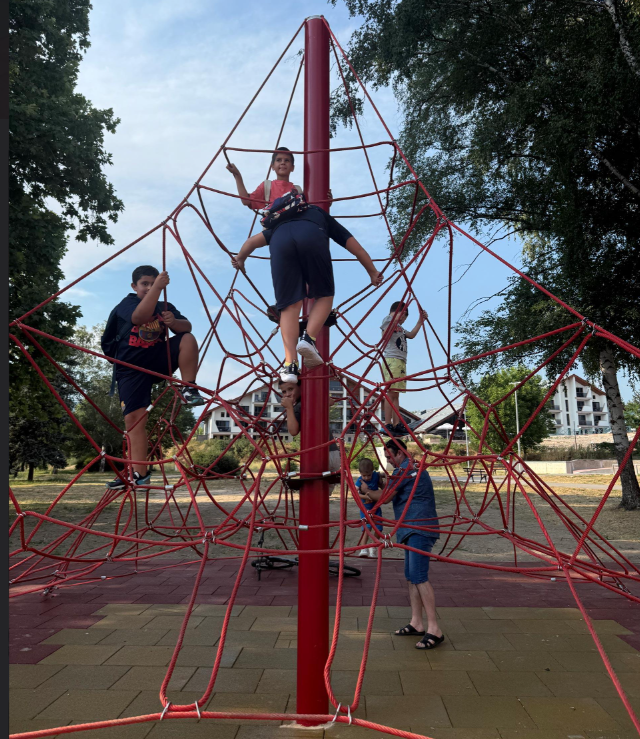
An adventure park for children
When a space needs to attract families and hold children’s attention naturally, a standard playground is not always enough. A well‑designed children’s rope park adds something more — purposeful movement, a clear sense of adventure, and an experience children want to repeat. For the investor or operator, this is not just an attraction but a tool for higher footfall, longer stays, and a more distinctive environment.
This is why rope‑based elements are appearing more and more often in hotels, school yards, children’s centres, public parks, and residential complexes. They combine physical activity, play value, and visual impact — but their success depends on far more than a good idea. The difference between an attraction that works reliably for years and one that creates problems lies in the design, the materials, the safety planning, and the way the entire system is engineered for the specific location.
What a children’s rope park really is
At its best, it is not just a series of ropes and platforms. It is a complete play environment where the route, heights, balance points, climbing elements, and transitions are arranged to be both challenging and accessible. For children, this balance is delicate — a route that is too easy quickly loses interest, while one that is too difficult reduces confidence and real usage.
This is why a children’s rope park must be tailored to age groups, expected capacity, and the level of supervision at the venue. Low‑rope configurations are often more suitable for schools, kindergartens, family hotels, and public spaces because they offer high play value with easier supervision and greater comfort for parents. More complex setups have their place, but usually in locations with clearly defined operations and dedicated staff.
Why this type of attraction delivers real value
The decision to build a rope park is rarely just aesthetic. It is tied to specific goals — activating an unused area, increasing family appeal, creating a distinctive feature in the project, or expanding the play offering beyond classic slides and swings.
From a user‑behaviour perspective, rope structures encourage longer stays. Children repeat the routes multiple times, try different ways of moving, and naturally create their own play scenarios. This makes the attraction more dynamic and more memorable. For hotels, retail spaces, and restaurants, this often means a better experience for families. For schools and municipalities — more meaningful physical activity in everyday life.
There is also deeper value. Climbing, balancing, and navigating obstacles develop coordination, spatial awareness, strength, and confidence. The child is not just playing — they assess risk, make decisions, adjust movement, and learn to progress step by step. This educational element is what makes the concept so powerful when executed professionally.
How to design a children’s rope park that truly works
The most common mistake is starting from the shape rather than the function. A beautiful visual concept is important, but it cannot compensate for poor movement flow, unsuitable height, or inappropriate difficulty. A strong project begins with a few clear questions: which children will use it, how intensively, in what environment, and what business or community outcome is expected.
Age and user profile
A rope park designed for preschool children requires a completely different logic than one intended for school‑age users. Younger children need lower levels, shorter transitions, clear visibility, and a strong sense of security. Older children can handle more complexity, varied obstacles, and a more dynamic route. When these groups are mixed without a clear structure, both safety and enjoyment typically suffer.
Space and environment
An outdoor rope park must match the climate conditions, usage intensity, and maintenance model. In coastal, mountain, or high‑sunlight areas, the choice of materials and coatings becomes especially important. Indoor solutions, on the other hand, offer better control over year‑round use but introduce different requirements related to building integration, evacuation routes, and visual harmony with the interior.
Capacity and operation
An attraction may look excellent on paper but turn out inconvenient in real use. If the entry and exit points are not well designed, if children intersect in narrow sections, or if the route does not allow a smooth flow, queues and tension quickly build up. For venues with high traffic, this is critical. Good design anticipates not only the play experience but also the way it will be managed day‑to‑day.
Safety without compromise
In rope‑based attractions, safety is not an add‑on — it is the foundation of the entire project. This includes proper engineering, high‑quality connectors, reliable load‑bearing elements, appropriate surfacing, precise dimensioning, and professional installation. In this type of environment, even small details matter because every component operates under constant dynamic load.
Equally important is integrating safety without diminishing the play experience. If the structure is overly restrictive, children lose interest quickly. If it is insufficiently protected, the risk becomes unacceptable. This is where the value of an experienced manufacturer and contractor becomes clear — finding the right balance between freedom of movement, challenge, and a controlled environment.
For investors, this means looking beyond the initial price. A cheaper solution often becomes more expensive if materials age quickly, the structure requires early repairs, or maintenance is complicated. The quality of craftsmanship, a traceable production process, and disciplined manufacturing are directly linked to the operational lifespan of the attraction.
Materials, durability and maintenance
A premium children’s rope park must look good not only on opening day but also after years of use. This depends on the choice of materials, the protections against weather conditions, and how realistically maintenance has been planned. Wood brings warmth and natural aesthetics, but it must be properly treated and applied in the right zones. Ropes, metal connectors, and platforms must be selected according to the specific load intensity and environmental conditions.
There is no universal formula. A public park with high footfall has a very different profile from a private educational centre or a resort complex. In one case, the priority is vandal resistance and easy maintenance; in the other — strong theming and higher aesthetic value. The best solution is the one that matches real‑world operation, not just the visual concept.
Where this format delivers the strongest results
In hotels and resorts, rope parks perform exceptionally well when they are part of a broader family experience. They can activate outdoor areas, provide a reason for families to stay longer on site, and enhance the perception of the venue as a family‑oriented destination. When the design is integrated with the landscape and architecture, the result is not only functional but also a strong marketing asset.
In schools and kindergartens, the value is different. Here the focus is on motor development, coordination, and daily physical activity. Low‑rope courses are particularly suitable because they combine movement and learning through play in an environment that teachers and parents perceive as safe and comfortable.
For municipalities and residential complexes, this type of attraction can become a distinctive community anchor. When placed correctly and clearly visible, it brings children together, energises the space, and increases the perceived quality of the environment. This is important when the project must deliver long‑term social and image value.
What to look for when choosing a contractor
When selecting a partner for a project like this, it is not enough to evaluate visualisations alone. What matters is the ability to deliver a complete solution, engineering competence, production control, and experience with real installations. The project must be conceived from concept to installation — not assembled from disconnected stages.
A good sign is when the contractor asks clear questions about the venue’s goals, audience, traffic, environmental conditions, and future maintenance. This indicates a professional approach. Equally important are quality standards and discipline throughout the process. For clients seeking a reliable long‑term investment, certified processes — including ISO 9001:2015 — are a real indicator of consistency and control.
In practice, the strongest results come from a tailored solution rather than a template. The space, the venue’s brand, the expected visitor profile, and the operational model must come together in a single coherent concept. This is exactly how companies like Edutain Attractions work — with a focus on safety, durability, premium execution, and attractions that deliver real value both for children and for the venue itself.
A well‑executed rope park is not just a place to climb. It is a sign that the space was created with intention — for movement, development, and genuine joy in play. When the solution is properly planned, it does more than fill an area: it gives children a reason to return, and gives the client confidence that they have invested in something meaningful and sustainable.
FAQ
1. What is a children’s rope park?
It is a complete play environment, not just ropes. Routes, heights and obstacles are arranged to be challenging yet accessible.
2. Why do rope parks create real value for a venue?
They activate unused areas, increase dwell time, create distinctiveness and support motor development.
3. How is an effective rope park designed?
By aligning with age groups, capacity, environment, movement flow and supervision. A beautiful concept cannot fix poor functionality.
4. What are the key safety factors?
Proper engineering, reliable load‑bearing elements, quality connectors, suitable surfacing and professional installation.
5. How do I choose the right contractor?
Look for end‑to‑end capability, engineering expertise, production discipline, certified processes and proven installations.

Maria Mihova
Published on: August 10, 2026 | Last Updated: August 10, 2026Founder & CEO at Edutain Attractions
Maria designs and delivers immersive, educational play experiences for hotels, municipal parks, and resorts worldwide. With over 15 years in international business development and adventure products, she builds play environments that combine safety, learning, and fun. Find out more about me
